Heya out there, surfers, I bought my copy of Social Anarchism or Lifestyle Anarchism from Willow Books near the corner of Bloor st w. and St. George st. in Toronto.
This is the second book by Murray Bookchin that I have profiled for this blog. In my post about Remaking Society, I
noted how I had come to read (and to appreciate) Bookchin after an
adolescent interest in the writings of Bob Black, including Black’s
elaborate anti-Bookchin essay, Anarchy after Leftism. Well, Black’s text (and his more recent anti-Bookchin eBook, Nightmares of Reason)
were inspired by Bookchin’s brief attack on the anarchist ideas put
forth by Black and a number of the other prominent anarchist voices of
the 1980s and 1990s, including Hakim Bey, David Watson (who himself
wrote his own Bookchin critique titled Beyond Bookchin) and John Zerzan (whose book Elements of Refusalhas
been profiled here). Bookchin terms these thinkers (minus Black,
Bookchin actually never mentions his most vocal opponent) the lifestyle
anarchists, who he argues bring anarchist praxis into concert with
consumer culture via Max Stirner’segoistic-anarchism.
This
book comes in two parts: the first is the admonition of this emerging
trend in anarchist thought in that period. Bookchin was primarily
concerned that the quasi-mysticism of Hakim Bey or the
return-to-the-primitive calls of John Zerzan sidestepped the need for
critique of actual social conditions that have concerned multiple
generations of earlier anarchist philosophers. Bookchin assess these
philosophies as taking the view that society is something to be dropped
out of, or obliterated completely, rather than reformed according to
specific critiques that address specific, material social problems.
The
second part of Bookchin’s short book is a brief essay titled “The Left
that Was”. This essay is a look back at what may be considered the “old
left” of the pre-1960s, when the first signs of the ideas expressed by
the lifestyle anarchists began to creep into leftist thought. In this
essay, Bookchin laments the past activity of organizations such as the
Industrial Workers of the World, and the Anarchists of the Spanish Civil
War (and early subject in Bookchin’s writing). While recent writers
such as Terrence Kissack note that this is a past that is gone, current
trends in activism such as the now global Occupy movement suggest that
the social aspect remains a vital part of activism.
The
Lifestyle anarchists are charged, by Bookchin, with basing their theories
on faulty science and anthropology. I’ve wondered, when reading the
primitivist texts of Zerzan and others, whether or not the anthropological texts he
cites were themselves rooted in an ideology partially formed by the era
it came out of, and according to Bookchin, they were. Many of the Primitivist understandings of early man come from
the published papers of a specific symposium called 'Man the Hunter' held in 1966 at the University of Chicago, where its participants
portrayed man as living in paradise before civilization. Bookchin
disagreed and, more recently, Theodore Kaczynski (The Unabomber) also
disagreed based on his own experience of living the lifestyle Zerzan
advocates. While the anarcho-primitivists describe pre-civilization life as easy-going, Kaczynski, in his essay 'The Truth About Primitive Life: A Critique of Anarcho-Primitivism' describes the demands such
a lifestyle places on labour needs as quite high. Kaczynski was speaking
from personal experience, having lived a mostly hunter-gatherer
lifestyle for over twenty years of his life.
Bookchin critiques the 'lifestyle' anarchist theories as not simply being
ungrounded but also as operating in accordance with contemporary consumer culture. The realization of the unique individual, the unlocking of the
personality, these are things that the lifestyle anarchists seek, and
things that consumer culture offers. Thomas Frank’s edited anthology Commodify Your Dissent
addresses this same issue but from the end of critiquing the advetising
that advocates rebellion, and the subcultures they feature. By now we
have had at least thirty years of commercials saying things like
“Toothpaste as unique as you are”, and there’s little reason to believe
that these sentiments are not mutually exclusive from the ideas of the
Lifestyle Anarchists, even if those writers would inevitably deny any
commonality with advertising slogans.
This
consumer/activist-anarchist dichotomy, however, is not particularly
helpful, coming from Bookchin, as it currently provides an incredibly
shallow argument to pundit types to discredit activists of many stripes.
That is not to suggest that pundits now discredit activists for using
consumer items because they read Bookchin’s attack on Hakim Bey and
David Watson, but I am suggesting that just as Bookchin’s found a tense
consonance between consumerism and certain strains of anarchist theory,
that very line of thought has found its own consoance with current
right-wing attitudes towards leftist action. In particular, the idea
that activists are not truly committed to any cause unless they can
prove themselves free of all consumer objects. For example when Occupy Wall Street began, photographs circulated across Internet channels that
highlit all of the commercially available objects that appear....
....as
though there’s some possibility for an Occupy protester to be using an
indie digital camera. Furthermore, this critique assumes that anyone
who owns a piece of consumer electronics is implicitly dedicated to
capitalism, acquired all of their possessions at retail, and in fact
presumes one of what Bookchin implies as a potential byproducts of lifestyle anarchism, that activism can
be merely a series of consumer choices. That activists are also
consumers is almost inevitable in contemporary society, but that
activists accept consumerism as a necessary social condition is not
inevitable. That activism can be practiced through ethical consumerism
is essentially new, however, and has produced interesting byproducts,
such as the phenomena of the hipster whose persona is built upon
consuming products that have acquired a subcultural cache.
Bookchin
refers to the difference between these two forms of anarchism as
radically divided, so that an individual cannot commit to both. This
argument appears extreme, and it is not explicitly clear why concepts
from “lifestyle anarchist” writers cannot be integrated into forms of
social anarchism. This text, however, is relevant for opening up an
ongoing debate between two generations of anarchist philosophers.
Hi there, fellow cybernet users, I borrowed Free Comrades: Anarchism and Homosexuality in the United States, 1895-1917 from the Toronto Public Library.
Anarchists,
social anarchists in particular, have always stood with the socially
vulnerable and have often expressed a degree of sympathy (if not
outright support) for the culturally deviant. Terence Kissack’s book Free Comrades: Anarchism and Homosexuality in the United States, 1895-1917
examines the interest and support pledged to GLBT issues by prominent
anarchist during the late 19th and early 20th century, when
homosexuality was largely criminalized by American society. Most of the
anarchists discussed in Kissack’s book were not avowedly homosexual,
but they spoke in favour of decriminalizing homosexuality and included
it in their visions for an anarchist society.
Terrence Kissack is the current treasurer (and was, formerly, the executive director) for the GLBT Historical Society
based in San Francisco California. This society, formed in the
mid-1980s, manages an extensive archive (and associated reading room) of
GLBT related documents and historical materials. The society also
sponsors the GLBT History Museum, which is currently featuring an
exhibition titled, “Our Vast Queer Past: Celebrating San Francisco's GLBT History”
that attempts to represent all aspects of Queer history in San
Francisco through historical objects and images. The museum also
curates online exhibitions using social media/user created content web
platforms, such as the Dykes on Bikes exhibition that’s now viewable on as a YouTube clip.
Free Comrades
is a book adaptation of Kissack’s doctoral dissertation, which he
received in 2004 from New York University. The book takes its title
from a publication called The Free Comrade,
published by John William Lloyd, an ardent supporter of radically
transcendentalist (and widely assumed to have been homosexual) American
poet, Walt Whitman.
Kissack's book does not, necessarily, focus upon homosexual anarchists, and
rather directs its spotlight upon issues and controversies of
homosexuality during the late 19th century and early 20th century, and
the anarchist interaction. An example is the second chapter, a
discussion of the support shown by anarchists such as Emma Goldman for Oscar Wilde during his persecution (and prosecution) for engaging in "gross indecency with other men".
Each
chapter develops along such lines, and Kissack is always sure to
contrast the Anarchist support for sexual freedom in America against
dominant voices of moral indignation at such ideas. While the
anarchists argued passionately for Wilde’s right to express his
sexuality in the wake the great writer’s arrest, mainstream cultural
commentators came to a collective revelation that Wilde’s work was
actually terrible. Kissack carefully contextualizes each of the sexual
crises or the queer-friendly cultural forms he discusses in its broad
socio-historical setting to create a strong sense of the hostile climate
anarchists and homosexuality was operating under. Even among
anarchists or political radicals the atmosphere was tense, as Kissack
notes that even some anarchists struggled with accepting anything other
than hetero-normative sexuality. John William Lloyd, the previously
mentioned great admirer of Whitman and who is noted, in Kissack’s text,
as having argued for a vast array of sexual experimentation as part of
an overall social revolutionary program, came to renounce Walt Whitman
and same-sex relations. Kissack calls this turn, “a moment of literary,
political and sexual panic,” and discusses a change in Lloyd’s writing
and use of language that involved a divestment of any word the radical
author perceived as having homosexual connotations. Kissack goes on to
discuss the cultural context for this change which demonstrates the
shifting intellectual ground that lay beneath these issues and createed
political tensions for those who gave voice to them.
Kissack’s
book is also full of histories of anarchists who never wavered from
their positive attitude towards queer rights and issues. Foremost among
them was Emma Goldman, who appears throughout Kissack’s text, and
throughout virtually any text that discusses the intersection of
anarchists and the socially vulnerable in early 20th century America.
There is also a chapter devoted to Alexander Berkman and his book, Prison Memoirs of an Anarchist,
which included memories of homosexual desire that Berkman experienced
during his 14 year incarceration. Furthermore, Kissack discusses how
cynical political commentators of the early 20th century used
insinuations of lesbianism, particularly in regard to the friendships
Emma Goldman had with other women, as a derogatory metaphor for radical
politics - a rhetorical flourish that persists in the right-wing
repertoire. In fact, many of the historical issues Kissack raises in
this text are ongoing today. What has whithered from the popular public
sphere is the voice of the radical left.
By the way - Here’s part one of a video of Terrence Kissack discussing, and reading from, this book:
ADILKNO is a contraction, of sorts, that stands for the Society for the Advancement of Illegal Knowledge. That this ‘society’ involved three individuals including the currently active Dutch media theorist Geert Lovink, is about as much information as I can dredge up about the group. Autonomedia has published two books by the society, The Media Archive, a collection of short speculative essays on media that is largely incomprehensible. I don’t know if its incomprehensible because ADILKNO sought to exceed Jean Baudrillard in his use of obfuscating language and Marshall McLuhan in his willingness to speculate on media forms, or if its incomprehensible because the translation lacks clarity.
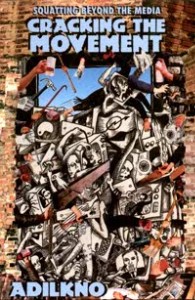
Cracking the Movement: Squatting Beyond the Media is the other ADILKNO book in the Autonomedia catalogue, and like Media Archive, it too suffers from incoherence at parts, likely due to its translation. Cracking the Movement is an oral history of the squatters movement in Amsterdam during the 1980s. It describes, from a small number of different points of view, the major events of this movement at this time, albeit sometimes in an excruciatingly detailed fashion. Before summer 2010, when the Dutch government passed anti-squatting laws, taking an unoccupied building space for living purposes was legal provided certain conditions were present. During the 1980s, according to ADLINKO, there was a huge population of homeless in the Netherlands, and people (many of whom were punks and anarchists) started taking vacant housing for themselves.
From these squats, most notable among them the Groote Keyser, the squatters built up a communities of their own that included squat bars and systems of communication (newspapers and radio). The squats were both a launchpad for activist movements, and a prescient social issue in themselves. ADLINKO and their sources discuss how the squats were continually contested terrain under attack from police, landowners, fascist bullies, and rival squatters. They also discussed the conditions of Amsterdam during this period, such as a mix of poverty and gentrification that encroached upon the working class neighborhoods, and a city blanketed in garbage and dog waste. The activists from the squats fought against the city’s bid for the 1992 Olympic games, and fought against police after a squatter named Hans Kok died in a police station cell. The chapters often describe rapid shifts from relaxing and drinking beer to all-out direct action engagement with a social enemy.
The structure of Cracking the Movement is that of an oral history, in that much of the chapters are made up of transcribed verbal statements given by participants in the events of this squatting movement to the authors (who, by the way, were also participants). The book’s subtitle is “squatting beyond the media” implying that there was a chronically negative media portrayal of the squatters during the period, and this oral history was a means of asserting their own version of events. Presumably this is a situation that has not changed, as police and politicians continue to have a friendly relationship with an acritical and unquestioning newsmedia apparatus.
As I have already hinted at in an earlier paragraph, often these oral statements are incredibly detailed, and spare no minor element to a story. The level of detail presented by this text may be tedious to read, however it gives researchers a strong sense of context for this squatter movement, the people involved in it, and the events that directed its focus. It is occasionally a difficult text to read, possibly because of the translation from Dutch to English, as the language becomes nonsensical in parts, and incredibly convoluted in others. I suspect that this is due to the translators wish to preserve the rich detail that exists in the original Dutch text, but any reader of the English version should be mindful of translation issues before dismissing the book.
The full text of Cracking the Movement is available online from a number of sources including at textz.com.
Contemporary Voices of White Nationalism is the second book that I’ve read by Carol M. Swain. This text can be viewed as a companion to her book, The New White Nationalism in America, which has already been profiled on this blog, and which purports to analyze and critique new forms of radical hate organizations in pre-Millennial America. In this book Swain and her collaborator, Russell Nieli (a lecturer at Princeton University), interview several leading figures of the contemporary White Power scene that Swain already discussed at length. Such individuals as Lisa Turner of the World Church of the Creator (a footnote mentions that she has since left this organization) National Alliance leader William Pierce (now deceased, but arguably the most influential American Neo-Nazi of the last forty years) David Duke, Jared Taylor of American Renaissance, Matthew Hale (currently incarcerated), and a number of others are all given a forum by Swain and Nieli.
The book reveals the interviewees as articulate and thoughtful despite their hateful rhetoric. This is not necessarily surprising since the interview subjects are already the spokespeople for a variety of hate organizations, and being articulate and thoughtful is their only real job. Interestingly, many of these subjects, such as David Duke, have internalized aspects of politically correct discourse (despite their overt hostility to that form of language) and position themselves as simply crusaders for equal rights for the white race. The implication is that granting equal rights to all races is, in fact, to give preference to all non-white races, even though there was a time when white-preference was taken for granted and a social structure that largely remains in-tact to this day was built on such a principle. Typical of the speech of these leaders are expressions that the races are better off as separate but equal social entities. According to these society would function better, and everyone would be happier under the circumstances of racial separatism. As articulate as these interview subjects may be, they are essentially calling for a return to prehistoric tribal units where each group's name for themselves is also their linguistic term for 'people'.
The interviewers do not ask challenging questions of their subjects. Presumably this no-pressure approach was a means to elicit as much about their ideologies as possible when, I'm sure, they're treated with hostility in so many other contexts. In merely asking questions about their white power perspectives, however, this book is virtually useless. Leaders of fringe movements generally strain themselves to have their voices heard and make use of virtually every low-fi communications technology available to them to get their messages out. Conducting research on any of Swain and Neili’s subjects is not difficult as they have all made frequent use of the internet to speak in their own words. Furthermore the Anti-Defamation League and the Southern Poverty Law Center (possibly the two best sources for recent information on the racist right-wing) have been collecting information on all of these people for years. Contemporary Voices White Nationalism is only really notable for being a book.
Contemporary Voices White Nationalism significantly altered my perception of Swain's other book, The New White Nationalism in America... for the worse. The New White Nationalism in America goes to great length to present the contentious issues surrounding the affirmative action program, and suggesting that this is the issue that’s driving people towards White Nationalism organizations. Contemporary Voices of White Nationalism reveal that many of these leaders simply believe in the superiority of the white race over all other races and that affirmative action is a means of bringing inferiors into positions where they don’t belong. These interview subjects state such views themselves and no one needs to add any commentary to make their views clear. While Swain, in her extended discussion of white nationalism, suggests that there is a need for reform on affirmative action programs, Contemporary Voices brings Swain’s arguments back to this Earth, where the white nationalists are exactly the deranged bigots you would expect them to be. If there is to be a discussion on such programs, lets not have it at the request of fringe white power people.
The New Voices of White Nationalism shows its author (Swain) arguing that an emerging group of educated white-power radicals were gaining in strength because they were capable of articulating arguments about racial issues in a manner that appealed to a particular segment of the American populace. Contemporary Voices in White Nationalism shows that very group of educated white-power radicals to actually be pompous and intellectually bankrupt pseudointellectals (a number of them hold advanced degrees and some have or do hold academic positions) who base their racial views on scientific theories that are generally laughed at, and studies that are methodologically ridiculous. Many of the interviewees believe that the differences in the races are obvious, and are enunciated through the social performances of each race’s members. This kind of “just open your eyes, goddammit!” argument fails to consider that many races have previously functioned under an elaborate cultural edifice of white privilege that arguably still exists, which prevented non-whites from participating in society. The white nationalists who interest Swain tend to believe that white privilege is a natural right that has been subverted by the civil rights movement. The real truth to be apprehended by an aware gaze is that multi-cultural societies actually function fine. Generally people of different cultures can come into contact with one another without conflict erupting.
Unfortunately the memory of a past where society was organized strictly around white privilege lingers in the present day. The justification for that society was never based on anything truthful, but rather it was built (in part) upon the symbolic force of a large number grotesque racial stereotypes that continually return to haunt a minority of white folks who now must occasionally make contact with the embodiments of those repulsive images. What's difficult for these White Nationalist people is the reality that inherent white superiority is no longer a socially diffuse idea that lives in everyone's heads. As a closing note, I think that researchers who use this text and The New White Nationalism in America should also read Melvin L. Leiman's excellent text The Political Economy of Racism, as a counterpoint to some of Swain's textual representations of racial tensions and their causes.
Martha Cooper is a photographer with a long-standing interest in urban culture and particularly in graffiti art. Her work has been published in a variety of periodical publications (including National Geographic) and of her books, almost all relate to hip-hop culture and most of those pertain to graffiti, including her most famous work, Subway Art(published in 1984). She was also interviewed by Cedar Lewisohn in Street Art: The Graffiti Revolution, and is generally considered a pioneer in the representation of graffiti art.
One of Cooper’s talents has been to identify types of street art and capture as many different photographic representations of this type as she can. Books like Subway Art are categorical archives of a peculiar graffiti form, and within this form sub-categories are perceived. Cooper’s influence can be seen in books like Stencil Graffiti by Tristan Manco, where the author aggregates as many examples of one particular form into a single volume. The graffiti form Cooper collected into the book Going Postal is the mailing label image. Street artists use labels of various sizes as a medium to carry their art. Many of the label-works are writer’s tags, drawings-by-hand, and some are printed images. The obvious advantage of the use of the mailing label is that the act of creation is separated from the act of vandalism, thereby reducing risk of detection to the artist. The other advantage is that the United States Postal Service gives away its labels for free.
Going Postal contains hundreds of photos of mailing label graffiti in its 99 pages. After a brief introductory essay by the author, in which she describes her discovery of sticker art and her apprehension of different forms of its content, the book is devoted strictly to images. Cooper does contain numerous examples of each kind of content, from tags to amusing drawings, to political messages. These images are not grouped in any way and aside from a list of credits at the end of the book, there is very little information attached to the works. A reader may begin to take for granted that the images are all from the United States because USPS logos are left exposed on many of the works, but some images are drawn on German labels too. Cooper appears to give priority to the wide array of creative possibilities that these labels have opened for street artists. Information such as placement locations is not included, which is typical of street art books.
Going Postal is published by Mark Batty Publisher, a recently established book publishing company that appears to routinely release new books on street art.