Commodork: Sordid Tales from a BBS Junkie
Rob O’Hara
2006
Rob O’Hara’s self-published memoir of his relentless obsession with software piracy is an important contribution to the world of literature on the computer underground. O’Hara’s book is highly relevant for two reasons, the first is that the BBS (bulletin board system) is a largely forgotten communications medium that has been completely overshadowed by the rise of the internet. I’ve already discussed the forgotten medium of the BBS in my posts about the Phone Losers of America Complete zines book and the Cult of the Dead Cow book, but for a long time, BBSs were the chief mode of communication for the computer underground. The collective users of all the BBSs in the land produced a huge library of literature (mostly in the form of .txt files), engaged in extensive file trading, and developed a number of other practices that were unique to the medium.
The second reason why O’Hara’s book is interesting is because it focuses on the social practice of software piracy rather than the practice computer hacking which dominates the literature on the computer underground. While elements of computer hacking are featured in this book, the primary focus is on the lengths O’Hara went to to find new software for his Commodore 64 (and later, other computers, of course). Commodork is by no means an authoritative or scholarly look at software piracy, but its a start to a body of literature that should exist yet doesn’t. O’Hara also discusses other lesser aspects of the computer underground, including the demoscene and the lit scene.
This book presents the memories of computer usage of one man who had a strong drive to accumulate software. This book is a self-published work, which permits its author to blend personal anecdotes about attending parties and going to college into his stories about copying files from floppy discs. Like I had written in my previous post about outlaw biker Doug Ford’s Patch Holder, I am strongly in favor of more individuals from various subcultures publishing books about their experiences.
Phone Losers of America
Brad Carter
Big Beef Bueno Books
2010
297 pages
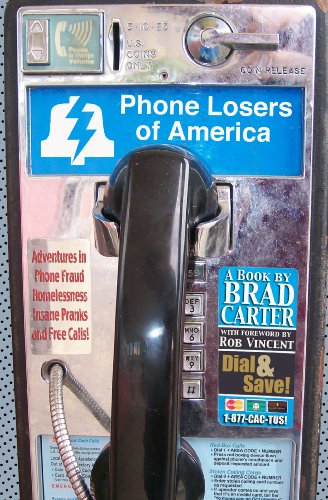
This book is part of a trend of 1980s/90s hack/phreak textfile groups who are printing anthologies or memoirs of their histories. In 2006 the Cult of the Dead Cow published The Book of Cao, an anthology of their txt files, while 2600 magazine (which has always a print magazine rather than a t-phile group) has published a ‘best of’ anthology in addition to an anthology of letters sent by readers titled Dear Hacker. Phone Losers of America is different from these other books in that it is a memoir, rather than an anthology, of Brad Carter (aka RedBoxChilliPepper) and his phone/hacker related pranks and adventures.
Brad Carter is the spiritual figurehead of the Phone Losers of America, otherwise referred to as the PLA. The PLA can be interpreted as a loose confederation of telephone prankster hackers who use www.phonelosers.org and its discussion forums as their headquarters. The PLA can also be thought of as Brad Carter and his friends, and the PLA mission may include anything amusing that they do. In addition to authoring this book, and editing (as well as writing, for the most part) 46 PLA .txt files, Carter also sporadically releases episodes of two different podcasts: PLA Radio, and Big Beef Bueno Podcast, and hosts the prank call focused radio program, The Phone Show. Carter’s activities are significant in the hacker world in that he and his associates eschew the white-grey hat hacker ethical pretensions in favour of exploiting the new frontier of network telecommunications as a vast forum for pranks and obnoxious behavior.
Carter’s text is divided into 23 chapters of varying formats. The PLA are known for embellishing their texts with dramatic or comedic flourish, and while Carter presents his book as a memoir, it begins with a brief bit of fiction about himself (named Alex in the text) and a friend. The pair were dumpster diving at a local telco office one night when a garbage truck picked up a dumpster while his friend was hiding in it. Alex fled town, believing that his friend, Doug, had died, and in flight his PLA adventures began. Following this opening, the each of the subsequent chapters (with some deviation) delve into a particular prank that Carter has pulled, either by himself or with accomplices. Some chapters recall the targetting of a particularly notable rube, some of whom are familiar to follwers of PLA forums or radio. Many of the chapters are re-written PLA text files detailing phonehijinks with cordless phones and other things, but some are escapades from after the text-file era, for example Carter’s replacement of a sign on a lawn of a McDonalds. Carter painstakingly mimiced the logo and the format of a sign that read “Our Team is Empowered to Guarantee Your Satisfaction” to instead read “Our Team is Well Endowed to Guarantee Your Pleasure”. This episode is unique in that it did not directly involve the internet or telephone in any way, but it is the sort of adventure Carter devoted much of his time to.
Many of Carter’s chapters detail activities that were meant to amuse. In the chapter titled 'eBay Feedback', for example, Carter notes that he has been a frequent user of eBay for many years, and that at some point he decided to play with the comments section. Carter would leave strange or silly comments on another sellers profile, with regards to a purchase, while leaving their seller rating intact. While this is an internet based prank, rather than telephone based, it reminds me of something I read about the legality of prank phone calls. I’ve read that the reason no one has ever been convicted of making prank phone calls is because making a call for the purposing of amusing the callee fits within the bounds of correct telephone use.
Travel is another theme of Phone Losers of America. Carter moved frequently around the United States, and as he described in a chapter titled ‘Homelessness’, he occasionally lived without a home and instead lived in bus stations or his vehicle. In addition to this, Carter described (in a chapter that I’m not sure is fiction or not) acquiring free air-travel within the united states via credit card fraud. Carter’s textual identity is certainly unstable, but he positions himself as alternating between jet-set fraudster, and nihilistic vagabond prankster.
Phone Losers of America is interesting because it embraces an aspect of the computer underground that is unacknowledged by most books about hackers. That is the potential for fun and mischief that a dominant reliance on computer technology has opened. Unlike Michael Calce in Mafiaboy, Brad Carter does not present Alex as interested in showing off his technological prowess or driven for the hidden knowledge that lies somewhere beyond a password prompt. Alex appears to be motivated by a desire to laugh at the anger of others. He he disregards emerging forms of etiquette and directs most of his technological knowledge towards achieve this.
Mafiaboy: A Portrait of the Hacker as a Young Man
Michael Calce and Craig Silverman
Penguin
2008
277 pages
Mafiaboy: A Portrait of the Hacker as a Young Man, details the life of a Canadian teen-aged computer enthusiast, Michael Calce, who entered the underground world of hackers under the alias Mafiaboy. In February 2000, when Calce was 15 years old, he was arrested by the RCMP after a series of brazen attacks on high-profile websites such as cnn.com. Mafiaboy is a memoir which recalls the thrill of hacking computers, the feeling of power that can be acquired by a knowledge-hungry youth who understands computer systems, and the fear experienced once their activities have been halted by force. Furthermore, the book contains warnings about the current state of “cybercrime” that extend beyond boundaries of a subculture of occasionally malicious computer nerds, into the realm of organized crime.
Like most contemporary memoirs, Michael Calce worked with a journalist, Craig Silverman, to produce this textual account of the Mafiaboy exploits. Silverman is a Montreal based journalist who manages the www.regrettheerror.com website, which details journalistic errors in print and broadcast news. Otherwise, according to his website profile, Silverman has organized ‘Hacks/Hackers Toronto and Montreal’, which are meetings between ‘hacks’ or journalists, and ‘hackers’ or subversive computer geeks. Calce and Silverman, together create the story of the hacker as an exciting yet cautionary tale of teen-aged technology-driven hubris. Finally, the book won the 2009 Aurthur Ellis award for best non-fiction crime writing, an award given by the Crime Writers of Canada
The text begins with an account of the hours surrounding the moment of Calce’s arrest, for his Internet activities, by the RCMP in an affluent Montreal suburb . The narrative then jumps back to the hacker’s early family history as he discussed his successful parents and their eventual divorce. Calce constructs himself as the paradigm of a hacker profile that has existed since the term ‘hacker’ was first applied to the malicious computer-loving youth in the early 1980s. Adolescent, male, middle-class suburban, from a broken home, prone to insolent behavior, these attributes have been the stereotypical hacker since the early BBS days, when graduate students started studying the, “computer underground”. Mafiaboy reads as though Calce may be, in part, telling us about his parent’s divorce and his change in attitude following the death of his best friend, to almost demonstrate that he was fated to go down the hacker path.
Calce and Silverman also include a brief history of hacking as part of their text. Much of their history chapter is derived from Stephen Levy’s book, Hackers and some other books that detail the lineage of the cultural practice. Perhaps this history aspect is included so that Calce can position himself as a point of convergence between the hacker subculture dating back to the 1960s, and his own family history of success in business but failure in family.
Elsewhere in the text, Calce rues his personal inability to keep his mouth shut about his own exploits. Like most transgressive subcultures, respect is given to individual hackers who break laws. The level of respect given to the transgressor is based on the scale and scope of their crimes. Hackers are notorious for bragging about their exploits and once Calce began to successfully disrupt the services on major websites, he felt compelled to tell others. This behaviour, of course, got him into trouble with (international) law enforcement. Hackers have been noted for having a need to have their accomplishments, and their knowledge, acknowledged and respected by others. There are unofficial hierarchies that form within the hacker subculture based on an individual's knowledge and level of skill with regards to using computer technologies. The interesting thing about this aspect of the text is that this book, at its core, can be read as an expression of a continuous need for such recognition in Calce. Mafiaboy was characterized by other hackers, and by the prosecuting attorney at his trial, as a relatively unskilled “script kiddie”. “Scipt Kiddie” is a term used by the hacker subculture that referrs to individuals who call themselves hackers but use pre-made hacking tools to wreak their havoc, rather than relying upon their own abilities.
The current wikipedia article for ‘Mafiaboy’ continues to refer to him as a ‘script kiddie’. Mafiaboy: A Portrait of the Hacker as a Young Man, seems to repeat a need felt by Calce to have his skills recognized. The former hacker seems at pains to explain that he did know computers, he did have prodigious computer skills, and he did have an intense need to understand them which drove his development. The implicit expression of this need for approval and understanding is probably the most interesting aspect of the text. This entire confessional is a grand return to the boastful hacker spirit, Calce needs us to know, as a young adult in 2008, how good he was with computers - and the extent of his will to do wrong with them - back in 2000, when he was in his early teens.
The Mafiaboy story moves through his trial, his detainment, and ends with him being reuinited with his friends after a (relatively) brief period of incarceration in a youth detention facility. The book ends with warnings about a new frontier in computer crime emerging from Russia that comes from the Russian mafia providing salaries to unemployed Russian computer programmers who can use their skills to extort money from North American Internet users. Calce and Silverman are suggesting what is on the horizon for cybercrime, and also perhaps suggesting that what Calce did back in the year 2000 was nothing compared to what may happen today to the average internet user.