Showing posts with label computer hackers. Show all posts

Sunday, March 31, 2013

anonymous - book - 2011 - Epic Win for Anonymous: How 4Chan's Army Conquered the Web


2011
304 pages

By now the phenomenon of Anonymous, an unspecified and unorganized mass of computer pranksters and social activists (popularly known as... ugh... ‘hacktivists’) is a part of the common imagination.  Everyone has at least seen images of protesters wearing Guy Fawkes masks (referencing not just the 17th century English anti-parliament terrorist but also the technique of mass identification with a social movement or anti-establishment attitude via obscuring one's individual identity as shown in the 2006 film V For Vendetta) or heard stories about members of anonymous hacking such and such institution or organization or declaring war via internet against a repressive regime. Less known (but still pretty well known) is that Anonymous, as a social movement, emerged from a specific online location, 4chan.org.

4chan.org was started in 2002 by a kid who calls himself m00t, real name Christopher Poole, who wanted to emulate Japanese anime discussion boards (specifically one called matsubara or 2chan). The site is interesting, in part, because it does not save any of the content that users contribute to it (some of the effects of which have been observed by an MIT research team) and therefore everything has to be constantly renewed. The repetition and variation on the forms that appear on 4chan have led to site users (who post under the name ‘anonymous’ and are not required to enter a username to contribute) to develop a large number of different graphic memes that have transcended the site, some of the more popular forms, like the LOLcats, have become mainstream pop culture phenomena. 4chan.org is the opposite of Facebook and as a contemporary internet phenomena, is far more interesting (Facebook itself is not interesting at all but the discourse surrounding the service is.) While Facebook is a global data-mining operation posing as a good-vibes world funfest where people can post their opinions and expect only agreement in return, 4chan is a carnival of all of the most transgressive subjects and images including discussions about gore, pornography, drugs, etc.

Cole Stryker is a freelance journalist who appears to focus on trends in network communication technology and its cultural uses. In Epic Win for Anonymous he gives a fairly detailed history of 4chan and a survey of its uses. Stryker’s text is not heavy on analysis, cultural or otherwise, but it still helps a lot in forming an understanding of the phenomena of Anonymous, their origins in hacking and online trolling/flame wars, as well as predecessors to 4chan site that fostered the kind of transgressive (verging on nihilistic attitude) that appears to dominate. Epic Win for Anonymous is a descriptive history of 4chan, its origins, and the actual social movements that have emerged out of it.

What interests me about Anonymous is that it’s never really clear what it is, because it isn’t something in particular. At its surface level it appears as a protest tactic, similar to the Black Bloc in its core emphasis on the intersection of mass protest and the protection of personal identity. On another level though, it is a form of mediated mass protest that appears to permit its participants to engage with their social causes to the extent that their individual technical abilities allow. If a target for direct action is selected (by whom, I’m not sure) then some Anons might proceed by breaking the target’s network security and obtaining documents, others make up mocking graphics with their photoshop skills, others might pile onto a denial of service attack, and some will don their Fawkes mask and attend the street protest.

Anonymous was, for example, instrumental in ensuring justice during the recent Steubenville rape trial, with Anons obtaining and disseminating the videos and images that served as evidence at trial, and also picketing the town through online action and street demos. Interestingly, this murky group that has grown out of an underground website largely devoted to exploring transgression had established a stable moral position with regards to that crime while much of mainstream America were perfectly willing to blame the victim for what happened to her, and to falter over what constitutes rape in their country.

The other level at which Anonymous is interesting, which Stryker discusses in his book, was the collective problem solving potential of the group. Anonymous is geographically dispersed yet they are localized (ugh...) virtually to 4chan. Occasionally a problem is brought to the group, sometimes in the nature of an image of an animal or child abuser, for example. The users of 4chan will use their collective knowledge to try to identify features of that image which can be used in identifying the abuser to authorities. This aspect of Anonymous reveals how much greater potential 4chan has at motivating people to action than the major social network websites. Facebook may be orders of magnitude more popular than 4chan, but 4chan’s impact on the culture has been immensely more meaningful than Facebook’s.

Saturday, February 16, 2013

computer hackers - book - 2010 - Dear Hacker: Letters to the Editor of 2600

Dear Hacker: Letters to the Editor of 2600
Emmanuel Goldstein (ed.)
Wiley Publishing Inc.
2010
576 pages

Much of the writing by and for hackers has, since the beginning, been primarily electronic text distributed via networks and BBS systems. Relatively recently, as has been discussed elsewhere on this blog, hack/phreak e-zines such as Cult of the Dead Cow and Phone Losers of America are finding print publication via various self publishing platforms. 2600 Magazine (a name taken from the ‘blue-box’ phreaker technology that played a 2600hz tone into a trunk line to seize telephone operator status for the caller) has, since 1984, been the one consistent print publication for the computer underground.The magazine has always focused on the analysis of telecommunications and computer systems, although it has also always taken a libertarian-tinged leftist political slant as well. In 2009 2600 published an almost 900-page ‘best-of’ anthology of the magazines articles. The single largest component of each issue, however, is the letters section, and this volume anthologized close to 30 years of correspondence with the publication.

Dear Hacker is an enormous collection of the letters that appear in 2600 magazine, introduced by Emmanuel Goldstein, the magazine’s founder and editor-for-life, who notes his own history of writing letters to magazines. Goldstein noted the importance of a reader responding to something they read in print, demonstrating their engagement with the media and participating in the social life brought into being by writing and publishing. Dear Hacker includes the unedited letters of hackers writing about every aspect of hacker culture, with the original editorial responses. Each chapter focuses on a different component of the full range of hacker concerns, such as dealing with law enforcement, hackers in prison, questions about technology, and questions about the magazine itself. These chapters are subdivided according to years, showing similar concerns revolving around changing technologies and environments as time proceeds. The book is not simply a collection of correspondence, it is also a history of a print magazine operating as a medium of active information exchange to a subculture that is based on the use of computers.


Maybe next 2600 will edit a book of Goldstein's editorials that begin each issue.


Tuesday, July 24, 2012

cult of the dead cow - book - 2006 - The Book of Cao: Enlightenment Through a Poke in the Eye


The Book of Cao: Enlightenment Through a Poke in the Eye
Cult of the Dead Cow
cDc Communications
Grandmaster Ratte’ & Myles Long (eds.)
2006
155 pages

Like the two Phone Losers of America books, The Book of Cao is a print publication containing material that was produced by a group txt-file writers belonging to what can be broadly referred to as the ‘computer underground’.  In the case of Cao, these text files were written over a six year period beginning in 1984, by a group of writers who called themselves the Cult of the Dead Cow (acronym: cDc) a small group of hacker weirdies that distributed their texts through the international BBS scene.  The cDc txt files were ubiquitous on the BBSs of the mid-1990s (when I used to call them), and they were probably one of the overall best known series of txt .files of the entire library produced by that scene.

The original Cult of the Dead Cow text files covered a variety of content, ranging from computer game instructions to lyrics from punk and metal albums.  What they are best remembered for are their absurd and disturbing literary txts that included scenes of graphic violence, sexuality, and assorted high weirdness.  The texts collected into The Book of Cao are those that come closest to underscoring the name the group gave to themselves, as they mostly focus on the cow as a creature of devotion, and of a harbinger of apocalypse.  Titles such as The History of the Bovinomicon, and The Nameless Pasture, evoke a bizarre cow-focused pastiche of H.P. Lovecraft’s already weird writing, while probably the most entertaining of the texts is the “issue” of “Cowbeater” magazine, which is a mock Tiger Beat for the hopelessly strange people who made up the BBS scene.

Again, like the PLA books, the material contained here is already available for free elsewhere, and has been for decades.  Unlike the PLA books, this book from the computer underground contains no hack/phreak content outside of some minor references, and instead puts the odd humour and deranged interests of the cDc members (who influenced large numbers of other txt writers) on 
display.  It should be noted then that the cDc are, in essence, a group of hackers who also had strong poetic/literary interests, and information pertaining to their hacktivist endeavours, while not mentioned in this book, can be found elsewhere.  They are a predecessor to Anonymous in their fight against Scientology, (cDc begain criticizing the church in 1995) for example, and also in their development of hacking tools (such as the infamous Back Orifice application).


Thursday, June 23, 2011

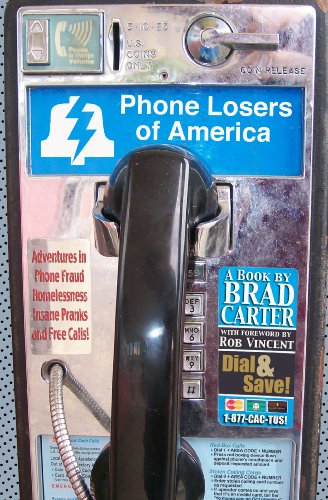
computer hackers - book - 2010 - Phone Losers of America

Phone Losers of America
Brad Carter
Big Beef Bueno Books
2010
297 pages

This book is part of a trend of 1980s/90s hack/phreak textfile groups who are printing anthologies or memoirs of their histories.  In 2006 the Cult of the Dead Cow published The Book of Cao, an anthology of their txt files, while 2600 magazine (which has always a print magazine rather than a t-phile group) has published a ‘best of’ anthology in addition to an anthology of letters sent by readers titled Dear Hacker.  Phone Losers of America is different from these other books in that it is a memoir, rather than an anthology, of Brad Carter (aka RedBoxChilliPepper) and his phone/hacker related pranks and adventures.

    Brad Carter is the spiritual figurehead of the Phone Losers of America, otherwise referred to as the PLA.  The PLA can be interpreted as a loose confederation of telephone prankster hackers who use www.phonelosers.org and its discussion forums as their headquarters.  The PLA can also be thought of as Brad Carter and his friends, and the PLA mission may include anything amusing that they do.  In addition to authoring this book, and editing (as well as writing, for the most part) 46 PLA .txt files, Carter also sporadically releases episodes of two different podcasts: PLA Radio, and Big Beef Bueno Podcast, and hosts the prank call focused radio program, The Phone Show.  Carter’s activities are significant in the hacker world in that he and his associates eschew the white-grey hat hacker ethical pretensions in favour of exploiting the new frontier of network telecommunications as a vast forum for pranks and obnoxious behavior.  

Carter’s text is divided into 23 chapters of varying formats.  The PLA are known for embellishing their texts with dramatic or comedic flourish, and while Carter presents his book as a memoir, it begins with a brief bit of fiction about himself (named Alex in the text) and a friend. The pair were dumpster diving at a local telco office one night when a garbage truck picked up a dumpster while his friend was hiding in it.  Alex fled town, believing that his friend, Doug, had died, and in flight his PLA adventures began.  Following this opening, the each of the subsequent chapters (with some deviation) delve into a particular prank that Carter has pulled, either by himself or with accomplices.  Some chapters recall the targetting of a particularly notable rube, some of whom are familiar to follwers of PLA forums or radio.  Many of the chapters are re-written PLA text files detailing phonehijinks with cordless phones and other things, but some are escapades from after the text-file era, for example Carter’s replacement of a sign on a lawn of a McDonalds.  Carter painstakingly mimiced the logo and the format of a sign that read “Our Team is Empowered to Guarantee Your Satisfaction” to instead read “Our Team is Well Endowed to Guarantee Your Pleasure”.  This episode is unique in that it did not directly involve the internet or telephone in any way, but it is the sort of adventure Carter devoted much of his time to.

Many of Carter’s chapters detail activities that were meant to amuse.  In the chapter titled 'eBay Feedback', for example, Carter notes that he has been a frequent user of eBay for many years, and that at some point he decided to play with the comments section.  Carter would leave strange or silly comments on another sellers profile, with regards to a purchase, while leaving their seller rating intact.  While this is an internet based prank, rather than telephone based, it reminds me of something I read about the legality of prank phone calls.  I’ve read that the reason no one has ever been convicted of making prank phone calls is because making a call for the purposing of amusing the callee fits within the bounds of correct telephone use.  

Travel is another theme of Phone Losers of America.  Carter moved frequently around the United States, and as he described in a chapter titled ‘Homelessness’, he occasionally lived without a home and instead lived in bus stations or his vehicle.  In addition to this, Carter described (in a chapter that I’m not sure is fiction or not) acquiring free air-travel within the united states via credit card fraud.  Carter’s textual identity is certainly unstable, but he positions himself as alternating between jet-set fraudster, and nihilistic vagabond prankster.  

    Phone Losers of America is interesting because it embraces an aspect of the computer underground that is unacknowledged by most books about hackers.  That is the potential for fun and mischief that a dominant reliance on computer technology has opened.  Unlike Michael Calce in Mafiaboy, Brad Carter does not present Alex as interested in showing off his technological prowess or driven for the hidden knowledge that lies somewhere beyond a password prompt.  Alex appears to be motivated by a desire to laugh at the anger of others.  He he disregards emerging forms of etiquette and directs most of his technological knowledge towards achieve this. 

Tuesday, May 31, 2011

computer hackers - film - 1982 - Tron

Tron
Disney 
1982
Director: Steven Lisburger
Writer: Steven Lisburger
96 minutes


Hello everybody in cyberland!  Here’s my first “blog” post on the compu-net.  I hope the good netizens of the world approve!

I borrowed Tron from the Toronto Public Library.  In 1982 there was a popular sense that the personal computer had opened a new frontier for outlaw activity.  But because computers are essentially office equipment, there was little about hacking to make it into an exciting source of cinematic action.  Wargames, released in 1983, portrayed computer hacking as a pursuit for disaffected, underachieving teenagers.  Matthew Broaderick played high-school hacker David Lightman whose exploits plunged him into a cross-country fugitive adventure with cold war era Nuclear-apocalyptic overtones.  The post-cold war film, Hackers, released in 1995, maintained the teen-aged outlaw portrayal of hackers although the film bestowed upon them roller-blades and mid-90’s club kid style and attitude.  Both Wargames and Hackers represent computer hackers as mildly malevolent kids who possess a knowledge of the weaknesses of contemporary technologies and infrastructure that gets them into, and out of, tense situations.  Tron predates these films and charts a unique path among hacker movies, where the hacker enters the computer and conquers its internal landscape.
  
Tron is unique because its basic narrative revolves around anthropomorphized computer programs. The programs are represented as men who fight with each other for survival.  Much of the movie takes place inside of a computer system that is being hacked by former programmer and current arcade owner, Kevin Flynn.  Flynn seeks the evidence that his video game designs have been stolen from him by Ed Dillinger, the film’s villain who is currently an executive of the company Flynn used to work for, a software development firm called ENCOM.  While Tron’s hackers are grown-up software industry professionals, Flynn exists in a state of perpetual adolescence.  He is first alluded to by Alan Bradley, a former colleague, in conversation with Lora Baines, also a former ENCOM colleague as well as an ex-girlfriend, as a programmer who wastefully used his considerable talent to program games.  He first appears in the film as the centre of attention, surrounded by enraptured kids, achieving a high score on a game machine in his arcade.  That scene recalls a time when the video arcade was a space where heroes were made.  I suspect that this brief scene, displaying the handsome and fun loving Flynn, surrounded by girls that are amazed by his gaming abilities, provides the model for the nighttime fantasies of the sad subterraneans who populate the King of Kong and Chasing Ghosts documentaries.   

Flynn at the arcade.


Video game great, Robert Mruczek, is featured in the 2007 documentaries The King of Kong, and Chasing Ghosts: Beyond the Arcade.


This film quickly progresses from displaying Flynn’s hacking efforts, where he types at a keyboard, to zapping him into inner-space of the computer via some kind of transmogrifier.  While the computer interior should probably be a domain under the MCP’s  complete control, it is actually a chaotic realm subject to the same unpredictable shifts in power as any other landscape populated by people of divergent interests and motivations.  Dellinger’s avatar within the computer, Sark, is Tron’s Darth Vader.  He is a military leader who orders his red guard around.  The Red’s are Fascistic foot soldiers that seem to take computer programs hostage and force them into armed combat with one another.  The film’s title refers to a network security program, designed by Alan Bradley, that is essentially a powerful hacking tool.  In the computer realm, Tron is a figure who is preternaturally skilled at overcoming any of the challenges Sark throws at him, and is such a powerful new program that he is essentially destined to succeed in destroying the MPC, which, of course, happens in the end.  Similarly, Flynn is not an avatar but is rather a user materially transported into the machine.  Computer users are regarded as godlike entities by the anthropomorphic programs in Tron, and therefore Flynn is considered a power previously unseen in the space.  Within the computer realm, hacking is game-playing, and Flynn’s honed game skills put him on par with Tron in terms of breaking through Sark and MPC’s security systems.  

Tron has succeeded in finding a way of representing hacking as adventurous in a way that is interesting to cinema.  In most hacker films, the scenes in which the hacking being done are the least interesting, generally, and the inevitable post-hacking run from the police or whoever is where the action is.  Of course, Tron succeeds at this by removing anything that resembles actual hacker activity and turning the whole enterprise into an adventure quest, but so what?  Tron’s aesthetic is also really great, as the whole computer world is a light-blue monochrome against a black sky, and every character glows red or blue.  The evil Master Control Program is represented as a spinning glowing monolith that speaks, and for a film villain, is genuinely intimidating (although by 1982 Disney has long mastered the hero vs villain quest formula).
  
Tron is probably one of the first cinematic representations of the computer as a space to be explored, rather than a tool to be utilized.  Furthermore, the film presents the hacker as an outlaw hero whose knowledge of technology allows him to undo the wrongs of the powerful.  This mode of thought about hackers continues today where hackers such as Julian Assange of Wikileaks, to name a single example, claim to use their technological acumen in ways which appear morally questionable, but are vindicated when they achieve a moral good.  Flynn’s infiltration of ENCOM computers and the ultimate destruction of their property is vindicated by his discovery of proof that Dillinger stole his game code.  In the film, Flynn is detached from any hacker subculture, but the model he provides is identifiably present throughout the actual hacker world.


Labels

united states (55) 1990s (25) history (21) 1980s (20) 1960s (19) 2000s (18) 1970s (17) Canada (16) anarchism (15) punk (15) memoir (14) outlaw bikers (14) documentary film (11) civil rights movement (10) new york city (10) film (9) zines (9) 19th century (8) 1950s (7) 20th century (7) black panther party (7) irish republican army (7) 1940s (6) 2010s (6) beats (6) essays (6) hells angels (6) hippies (6) journalism (6) science-fiction (6) street art (6) the troubles (6) England (5) United Kingdom (5) anti-globalization (5) communalism (5) computer hackers (5) exhibition catalog (5) graffiti (5) homeless (5) international (5) labour strike (5) occupy wall street (5) organized labour (5) quebec (5) 1930s (4) France (4) IWW (4) biographical drama (4) dada (4) david graeber (4) drama (4) interviews (4) malcolm x (4) novel (4) provisional IRA (4) psychedelia (4) sncc (4) sociology (4) street gangs (4) surrealism (4) survivalism (4) transcendentalism (4) white nationalism (4) 1920s (3) 4chan (3) BBSs (3) Emma Goldman (3) Europe (3) Karl Marx (3) Texas (3) Toronto (3) anarcho-primitivism (3) anarcho-syndicalism (3) anonymous (3) anthology (3) anti-civilization (3) autobiography (3) banksy (3) comedy (3) critique (3) direct action (3) ethnography (3) football hooligans (3) hacker groups (3) hacking (3) journalistic (3) ku klux klan (3) labour (3) martin luther king jr (3) mongols (3) philosophy (3) radical right (3) reader (3) situationism (3) student movement (3) vagabonds (3) white supremacy (3) william s burroughs (3) /b/ (2) 1910s (2) 1981 Hunger Strikes (2) AFL-CIO (2) Alexander Berkman (2) American South (2) American revolution (2) Andre Breton (2) Arab Spring (2) Australia (2) Baltimore (2) Cromwell (2) English Revolution (2) Fidel Castro (2) Germany (2) Greece (2) Levellers (2) Manchester (2) Marcel Duchamp (2) Max Ernst (2) Mikhail Bakunin (2) Montreal (2) NAACP (2) Peter Kropotkin (2) Portland Oregon (2) Ranters (2) Robin Hood (2) Salvador Dali (2) Southern Poverty Law Center (2) action film (2) animal liberation (2) anti-capitalism (2) anti-war (2) anti-war movements (2) article (2) aryan nations (2) avant-garde (2) bandidos motorcycle club (2) biography (2) black flag (2) black power (2) blek le rat (2) brook farm (2) crime drama (2) critical mass (2) cults (2) cultural criticism (2) david duke (2) design (2) diary (2) dishwasher pete (2) east bay dragons (2) eldridge cleaver (2) environmentalism (2) fan fiction (2) gerry adams (2) historical drama (2) historical survey (2) hobos (2) how to guide (2) indigenous struggle (2) internet memes (2) ireland (2) italy (2) jack kerouac (2) jared taylor (2) john waters (2) john zerzan (2) julian assange (2) keith haring (2) mail art (2) media criticism (2) mohawk warriors (2) mole people (2) murray bookchin (2) musical (2) mysticism (2) nativism (2) new age (2) nomadism (2) northern ireland (2) occupy movement (2) official IRA (2) oka crisis (2) operation black rain (2) oral history (2) paranoia (2) paul goodman (2) philip k dick (2) phone losers of america (2) photobook (2) phreaks (2) piracy (2) posse comitatus (2) prank phone calls (2) primary source (2) revolution (2) sabotage (2) self-publishing (2) shepard fairey (2) spain (2) student protest (2) terrorism (2) the order (2) travel (2) tristan tzara (2) true crime (2) txt files (2) ulrike meinhof (2) underground media (2) unorganized militias (2) 1%ers (1) 17th century (1) 1860s (1) 1900s (1) 1969 (1) 1970 (1) 1972 Bloody Sunday (1) 1980s. memoir (1) 2009 (1) 2011 (1) 2600 Magazine (1) Alberta (1) Alexandros Grigoropoulos (1) Amsterdam (1) Arthur Segal (1) Athens (1) Ben Reitman (1) Bethel (1) Bill Haywood (1) Boston (1) Brad Carter (1) Brendan Hughes (1) British Columbia (1) Burners (1) Burning Man (1) CLASSE (1) Captain Mission (1) Cass Pennant (1) Charles Fourier (1) Chartists (1) Che Guavara (1) Christopher Hill (1) Christopher Street Liberation Day (1) Columbia University (1) DOA (1) Darkthrone (1) David Ervine (1) Dead (1) December 2008 riots (1) Derrick Jensen (1) Dial (1) Diggers (1) Diggers (1650s) (1) Dorothea Tanning (1) Drop City (1) E.D. Nixon (1) East Side White Pride (1) Edward Winterhalder (1) Egypt (1) Emiliano Zapata (1) Emory Douglas (1) Emperor (1) Eric Hobsbawm (1) Eugene V. Debs (1) Exarchia (1) FLQ (1) Factory Records (1) Fenriz (1) French Revolution (1) GLBT rights (1) Gabriel Nadeau-Dubois (1) Gandhi (1) Gay Activist Alliance (1) Geert Lovink (1) George Washington (1) Georges Janco (1) Great Depression (1) Groote Keyser (1) Harlem (1) Haymarket Bombing (1) Henry David Thoreau (1) Henry Rollins (1) Hillel (1) Ho-Chi Minh (1) Hunter S Thompson (1) Hunter S. Thompson (1) Idaho (1) India (1) Indignados (1) Inter City Firm (1) Irish national liberation army (1) Isidore Isou (1) Jack Cade (1) Jeff Ferrell (1) John Humphrey Noyes (1) Joy Division (1) Kemal Ataturk (1) King Alfred (1) Konstantina Kuneva (1) LETS system (1) Labor Party (1) Lenin (1) Leonora Carrington (1) Lettrisme (1) Libertatia (1) Louis Aragorn (1) Luddites (1) Madagascar (1) Mafiaboy (1) Maine (1) Mao Tse-Tung (1) Maple Spring (1) Marcel Janco (1) Margaret Fuller (1) Mark Rudd (1) Martin McGuinnes (1) Mayhem (1) Michigan Milita (1) Moncton (1) Montgomery Bus Boycott (1) Morris Dees (1) Movement Resource Group (1) Mulugeta Seraw (1) National Film Board (1) Ned Kelly (1) Netherlands (1) New Brunswick (1) Norway (1) OK Crackers (1) Occupy Homes (1) Oklahoma (1) Oklehoma (1) Oneida Community (1) Ontario (1) Oscar Wilde (1) Oslo (1) Owen Sound (1) Pagans Motorcycle Club (1) Palestinian nationalism (1) Patrick Henry (1) Paul Eluard (1) People's Kitchen (1) Phalanx Communities (1) Philadelphia (1) Phillipe Soupault (1) Process Church (1) Quakers (1) Randy Weaver (1) Raoul Vaneigem (1) Raymond Pettibon (1) Rene Magritte (1) Robespierre (1) Robiespierre (1) Romania (1) Rome (1) Rosa Parks (1) Rubell Collection (1) Ruby Ridge (1) Russian Revolution (1) Sacco and Vanzetti (1) Samuel Gompers (1) Sinn Fein (1) Situationist International (1) Society for a Democratic Society (1) Sojourners for Truth and Justice (1) Staughton Lynd (1) Surrealists (1) Switzerland (1) T.A.Z. (1) The Rebels (Canada) (1) Thessaloniki (1) Thomas Paine (1) Timothy McVey (1) Tobie Gene Levingston (1) Tom Metzger (1) Toronto Video Activist Collective (1) Tunisia (1) UVF (1) Ulster Volunteer Force (1) Ultras (1) University of Moncton (1) Varg Vikernes (1) WWII (1) Walt Whitman (1) White Citizen's Council (1) Wisconsin (1) Woody Guthrie (1) Workers' Party of Ireland (1) Yes Men (1) Yolanda Lopez (1) Zurich (1) abbie hoffman (1) abolitionism (1) acadian nationalism (1) amana (1) american renaissance (1) anarchist black cross (1) anarcho-communism (1) andreas baader (1) anti-consumerism (1) anti-rent movement (1) arcades (1) arizona (1) art book (1) art history (1) art strike (1) assata shakur (1) atf (1) automatic writing (1) bandidos (1) bandits (1) bartering (1) bay area (1) bertrand russell (1) bicycles (1) biker church (1) bikies (1) black lives matter (1) black metal (1) black radicalism (1) bob black (1) bob flanagan (1) bobby seale (1) bryon gysin (1) business (1) caledonia conflict (1) cats (1) chicago (1) chicago 68 (1) chicago 8 trial (1) children's book (1) chris carlsson (1) chris kraus (1) church of life after shopping (1) church of stop shopping (1) civil disobedience (1) comic book (1) commentary (1) commune (1) communism (1) confidential informants (1) conscientious objectiors (1) contemporary (1) cope2 (1) core (1) correspondence (1) crimethinc ex-workers collective (1) critical race studies. (1) critque (1) crossmaglen (1) cult of the dead cow (1) cultural theory (1) culture jamming (1) cybercrime (1) cycling (1) daniel domscheit-berg (1) david dellinger (1) david watson (1) dead kennedys (1) debbie goad (1) decollage (1) dishwashing (1) donn teal (1) drag (1) drill (1) drugs (1) dumpster diving (1) dwelling portably (1) ed moloney (1) education (1) educational (1) elliot tiber (1) emmet grogan (1) environmental movement (1) errico malatesta (1) fanzines (1) fay stender (1) feminism (1) ferguson (1) folklore (1) front du liberation du quebec (1) gay pride (1) general strike (1) george jackson (1) georges bataille (1) gerard lebovici (1) gnostic (1) graffiti research lab (1) guerrilla filmmaking (1) guide (1) guy debord (1) guy fawkes (1) hakim bey (1) hans kok (1) harmonists (1) hiphop (1) huey newton (1) humour (1) icarians (1) illegal immigration (1) immigration movement (1) independence movement (1) industrial workers of the world (1) inspirationalists (1) insurrection (1) islamophobia (1) jay dobyns (1) jean baudrillard (1) jean-michel basquiat (1) jello biafra (1) jerry adams (1) jerry rubin (1) joe david (1) johann most (1) john birch movement (1) john cage (1) john lewis (1) journal (1) judith sulpine (1) juvenile literature (1) kathy acker (1) keffo (1) ken kesey (1) kenneth rexroth (1) know-nothings (1) lady pink (1) language rights (1) lifestyle anarchism (1) literature (1) london (1) london ont (1) long kesh (1) los angeles (1) manifesto (1) martha cooper (1) marxism (1) masculinity (1) matthew hale (1) max yasgur (1) may day (1) medgar evers (1) merry pranksters (1) mexican mafia (1) michael hart (1) michael lang (1) micro-currency (1) microcosm publishing (1) middle-east (1) mini-series (1) miss van (1) mlk (1) mockumentary (1) mods and rockers (1) moot (1) nation of islam (1) national vanguard (1) native american party (1) neal cassady (1) neo-confederacy (1) neoconservatism (1) neoism (1) new left (1) noam chomsky (1) nolympics (1) non-violence (1) nonsense (1) north africa (1) notes from nowhere (1) obey giant (1) occupy london (1) occupy oakland (1) october crisis (1) oral biography (1) pacifism (1) parecon (1) peasant rebellion (1) perfectionists (1) photomontage (1) pirate radio (1) pirate utopias (1) poachers (1) poetry (1) polemic (1) police brutality (1) political science (1) popular uprisings (1) portland (1) post-WWII (1) prank (1) protest (1) radical art (1) radical left (1) ralph waldo emmerson (1) real IRA (1) red army faction (1) regis debray (1) retort (periodical) (1) reverend billy (1) rock machine (1) ruben "doc" cavazos (1) san francisco (1) scavenging (1) script kiddies (1) scrounging (1) secession (1) second vermont republic (1) self-published (1) semiotext(e) (1) sexual politics (1) shakers (1) shedden massacre (1) short stories (1) simulation (1) slab murphy (1) slave revolt (1) snake mound occupation (1) social ecology (1) socialism (1) solo angeles (1) sonic youth (1) sonny barger (1) south armagh (1) spirituality (1) squatting (1) stage performance (1) stencil graffiti (1) stewart home (1) sticker art (1) stokley charmicael (1) stokley charmichael (1) stonewall riots (1) straight-edge (1) street theater (1) subgenius (1) survey (1) sylvere lotringer (1) tariq ali (1) teacher (1) ted kaczynski (1) television (1) tent city (1) terror (1) thermidor (1) timothy leary (1) train-hopping (1) tramps (1) trickster (1) trolling (1) tunnel dwellers (1) undercover (1) underground press (1) underground railroad (1) uprising (1) urban infrastructure (1) utopian (1) utopian communities (1) vegan (1) vermont (1) war measures act (1) warez scene (1) weather underground (1) white power skinheads (1) why? (newspaper) (1) wikileaks (1) winnipeg (1) woodstock (1) word salad (1) world church of the creator (1) yippies (1) youth culture (1) z communications (1)