Showing posts with label anarchism. Show all posts

Sunday, December 28, 2014

anarchism - 1994 - Anarchism and the Black Revolution

Monkeywrench Press and The Worker Self-Education Foundation of the Industrial Workers of the World
1994
153 pages


This book, Anarchism and the Black Revolution, was a title that surprised me when I was trying to get to know the library book collection of the midwestern rural community college I was tasked with managing. Lorenzo Kom'boa Ervin is a black power activist and anarchist who spent from 1969 to 1983 in prison for hijacking an aircraft. Before his incarceration he spent the late 60s in the black power movement as a member of the Black Panthers. Towards the end of his prison term he began to write anarchist pamphlets which are collected in this small volume.


One of the most interesting aspects of the first of his pamphlets collected here, “Anarchism and the Black Revolution”, was that Ervin attempted to chart an anarchist course for black revolutionary action in the US, divergent from the Maoist or pacifist courses of action taken by black revolutionaries before him. Furthermore, he addresses, in a 994 piece, issues of white privilege among anarchists and tackles the question of why there aren't more people of colour in the anarchist scene, a question that radical movements keep returning to. Ervin noted that white anarchists exercise their white privilege when they sweep questions of race to the side in strict favour of focusing on class issues. Ervin argues that black workers (along with women) have historically, and continue to be, placed below white men, who, as unionists, are collaborators of oppression when they claim this privilege.


He also advocates for the development of an international Anarchist Black Cross network, the anarchist prisoner support group that took up his case in the late 70s.


He wrote these pamphlets in prison and I don't know how many other things he wrote after his release or if prison was his most productive time as an anarchist philosopher. He does emphasize direct action in his work which he took to extremes in the 60s with ‘skyjacking’, and he also emphasizes the importance of the worker to social movements, and advocates anarcho-syndicalism.

Tuesday, September 11, 2012

anarchism - book - 1964 - The Anarchists

The Anarchists
James Joll
Methuen & Co. Ltd.
1964 (2nd ed. 1979)
299 pages

One of the things I love about library books are the handwritten notes that are left in the page margins by other patrons. I know that vast numbers of library patrons hate that people make marks in these books and consider it disrespectful, but I love that each book can, over time, accumulate the specific signs of its use.  Almost every page of the copy of early sociologist George H. Mead’s Mind, Self and Society that I borrowed from UofT’s Robarts Library was so heavily underlined that it had the stippled texture of 19th century Japanese Prints. My secondhand copy of Shaughnessy Bishop-Stall’s Down To This, a diary of living in Toronto’s turn-of the century tent city, includes a handmade index on the inside back cover so that a previous reader could make certain aspects of the text accessible on his or her return to the book.  

I borrowed a copy of The Anarchists by James Joll, a British historian whose career was mostly focused on the politically radical (he also wrote a book about the Socialist Second International, and a biography of the Italian Marxist leader and philosopher, Antonio Gramsci) from the UofT Scarborough Library, and includes notes by other borrowers recommending other, better books on anarchist history.  While Joll’s book can now be seen as a truncated survey of anarchist thought that has, since its publication, been eclipsed in importance by more thorough studies like Peter Marshall’s Demanding the Impossible, at the time of its first publication The Anarchists was basically opening up the field of anarchist studies.  Joll charts a history of anarchist thought from the Gnostics of early Christendom to the anarchists of the Spanish Civil War, although he focuses most of his work on the anarchists of the 19th century: in particular on the thought and deeds of Mikhail Bakunin and Peter Kropotkin.  

Joll’s analysis takes a close look at the effects of anarchist writings and speech and the competing philosophical tendencies within the broad anarchist scene.  One of the notes written in the copy of this book that I read stated “an excellent book which, among other things, clears up many seemingly inconsistent ideas in anarchist thought is “Anarchism: A Theoretical Analysis” by Alan Ritter, 1980.”  This note doesn’t dissolve the value of Joll’s history but, in its recommendation of another text, it does mark the social function of library books and their ability to communicate between patrons.


Tuesday, May 8, 2012

anarchism - book - 2001 - Anarchy!: An Anthology of Emma Goldman's Mother Earth

Anarchy!: An Anthology of Emma Goldman's Mother Earth
Peter Glassgold (ed.)
Counterpoint
2001
428 pages

For a brief period of time in the early years of the twentieth century, Emma Goldman was a well known figure in American society.  She did lecture tours, speaking to audiences on a variety of subjects deemed uncomfortable to mainstream society (such as self-governance, birth control, and a number of other topics) and she wrote quite a bit on these subjects as well.  Beginning in 1906, Goldman began editing and publishing a journal for anarchist ideas and social commentary titled Mother Earth, which ran until 1917.  Mother Earth was a fierce publication that eventually blazed out of existence amid its calls against the United States involvement in the first world war and the US Postal Service deemed the final issue inappropriate for distribution through the mails.  Goldman and her work was also the frequent target of law enforcement, and she was often prevented from speaking to audiences by police and was ultimately deported from the United States (along with her partner and lover, Alexander Berkman) because the anti-conscription stance taken in Mother Earth was deemed treasonous under the Espionage Act.

Peter Glaasgold, a contemporary poet and writer, edited this anthology of materials that originally appeared in Mother Earth.  His anthology is structured around topics (such as the definition of anarchism) rather than chronology, although many of the topics considered, such as the aforementioned discussion of World War One, or the later Russian Revolution, have a strong historical component that imposes itself on the structure of the book (these topics come up towards the end of the anthology, just as they occurred towards the end of the journal's existence).  Glaasgold always includes a contextualizing statement with each item, thus placing the item into its historical-social setting, and into a history of Goldman's journal as well.

Much of Anarchy! is made up of material written by Goldman herself, however a number of other writers are featured as well.  Alexander Berkman is included, of course, and the work of many other notable anarchist voices of the early twentieth century, such as Voltairine de Cleyre, Peter Kropotkin, Hippolyte Havel, and even the Russian novelist and thinker Leo Tolstoy.  The book also includes a number of reproductions of some of the original covers of Mother Earth, including a couple by the great dada-Surrealist photographer Man Ray (one of which is featured on the anthology cover).

One of Man Ray's covers

Glaasgold's anthology provides readers with a good survey of early twentieth-century anarchist social commentary from the most prominent voices of that particular movement.  The writing of the pieces are very clear and show the forceful but reasoned rhetoric of people who are passionate, and thoughtful, about the positions they take on certain social issues.  Finally, the editor's own contributions help the reader make sense of these now distant issues

Saturday, May 5, 2012

anarchism - book - 2010 - We Are An Image From the Future: The Greek Revolt of December 2008

We Are an Image from the Future: The Greek Revolt of December 2008
A.G. Schwarz, Tasos Sagris, and the Void Network (eds)
AK Press
2010
371 pages

We Are an Image from the Future is a collection of statements and testimonies pertaining to the anarchist uprising in Greece that began at the end of 2008.  The spark was the December 6 killing, by police, of a teenager named Alexandros Grigoropoulos, in the Exarchia neighborhood (essentially an anarchist/activist district) of Athens.  Rioting began within an hour of the shooting, and it hasn’t really stopped.


Makeshift Memorial at the site of Alexandros Grigoropolous' shooting

This book is almost 400 pages of photos and statements about the riots that erupted in Athens and other Greek cities following Grigoropolous’ killing.  The immediate anti-athoritarian frustrations that the rioters expressed in those initial few weeks evolved into a variety of concerns that have carried a vast and complex social movement through daily direct actions right up to this year.  The book’s title is prophetic, of course, as most of the anti-austerity outbursts in Europe, the Wisconsin strikes, the “Arab Spring” and the Occupy movement, and all of the general global unrest, has followed Greece.  

Schwarz and Sagris’ book includes many testimonies by riot participants and activist organizers, describing what they did, and what they witnessed.  Included are many accounts of street fighting with police and discord amongst activists over planning and ideology (which are pretty standard components of such books) and expressions of outrage over the actions of police and government.  Aside from the killing of the Athens teen and the resulting riots, there were three stories included in We Are an Image that stood out to me.  The first was a description of the occupation of a television station while it was broadcasting from one of its studios.  The second was the discussion with photographer Kostas Tsironis, who took a photograph of a police officer pointing a gun at protestors and was subsequently censored and fired from his position at a conservative newspaper called Eleftheros Typos.  


Tsiorias' photo of the police
The third story, which was referred to often by other contributors to this book, was of the vicious acid attack on labour leader Konstantina Kuneva, who survived the attack which has since been regarded as a symbolic example of the intense cruelty of a capitalist system in decline.  The first of these stories details the brazenness of the activists involved in these riots

We Are an Image of the Future is good for providing readers with the voices (it should be noted that many of the texts it includes were translated from Greek) of those people who were directly involved with the Greek riots of 2008.  It primarily gives readers the anarchist perspective on events, and more moderate leftist perspectives are largely absent, and the perspectives of the far right are not included to any extent.  Also this book is quite extensive and lengthy, and yet it only covers the first year of the events in Greece that have continued for at least three more years.

PS, a google image search on Kostas Tsiorias will result in many more images of the uprisings in Greece.

Tuesday, December 27, 2011

social radicalism - book - 1980 - A People's History of the United States: 1492-Present

A People’s History of the United States: 1492-Present
Revised and Updated Edition
Howard Zinn
HarperPerennial
1980 (this edition: 1995)


This will be a short profile of a book that has been discussed heavily in other forums since its publication.  A People’s History of the United States is a major work of history, focusing on political oppression in the United States and the radical social movements that emerged to respond to such oppression.  The book’s author, Howard Zinn, was a social activist, in addition to an academic, and he spent much of his career working at Boston University.  Zinn had been involved with the American Civil Rights movement (and one of his best known books is about the Students Non-Violent Coordinating Committee, an influential Civil Rights organizations which has been discussed previously on this blog in relation to John Lewis’ memoir), and later in the anti-war movement during the 1960s, and other social justice movements throughout his life.  

A People’s History, first published in 1980, was a response to all of the books of American history that focus on the European explorers, founding fathers, and industrialists who made the United States, bit by bit, into a superpower.  Zinn’s book looks at the social consequences of those historical stories that have made up the mythology of the United States, and examines how, historically, common people have been effected by the actions of America’s elites.  Zinn’s story is not just a narrative of social victims, however, as he heavily emphasizes the radical movements that emerged to fight political oppression, and each chapter seems to take a different aspect of this as its focus.  In Chapter 9, for example, Zinn discusses the institution of slavery in the America, but also the abolition movements that fought against slavery, and even discussed the details of several specific slave rebellions.  Labor Unions and Anti-War organizing are also persistent themes.  This book demonstrates that this alternative to the dominant telling of American history has its own heroes.

Some of the movements discussed by Zinn are virtually lost in most tellings of American history.  Chapter 10 is about the vestigial colonial mode of land ownership and management in the north during the 19th century and the Anti-Rent movement that erupted among agricultural workers who basically fought a war against land owners in New York state.  Zinn’s book also details the history of the anti-war movement during the Second World War, which is virtually unheard of in most histories of the period, which generally take up the line that WWII was the good war.  Finally, Zinn’s final chapter in this 1995 edition is about the first half of the Clinton years, with a critical analysis of the then current president’s commitment to progressive values.  Zinn published updates and revisions to this book quite often, and the final edition, published in 2005, contains a more complete chapter on the 1990s (including discussions of the Militia Movement, and Mumia Abu Jamal) as well as an analysis of the early Bush II years.

Tuesday, November 22, 2011

anarchism - book - 1995 - Social Anarchism or Lifestyle Anarchism: An Unbridgeable Chasm

Social Anarchism or Lifestyle Anarchism: An Unbridgeable Chasm
Murray Bookchin
1995
AK Press
86 Pages

Heya out there, surfers, I bought my copy of Social Anarchism or Lifestyle Anarchism from Willow Books near the corner of Bloor st w. and St. George st. in Toronto.

This is the second book by Murray Bookchin that I have profiled for this blog.  In my post about Remaking Society, I noted how I had come to read (and to appreciate) Bookchin after an adolescent interest in the writings of Bob Black, including Black’s elaborate anti-Bookchin essay, Anarchy after Leftism.  Well, Black’s text (and his more recent anti-Bookchin eBook, Nightmares of Reason) were inspired by Bookchin’s brief attack on the anarchist ideas put forth by Black and a number of the other prominent anarchist voices of the 1980s and 1990s, including Hakim Bey, David Watson (who himself wrote his own Bookchin critique titled Beyond Bookchin) and John Zerzan (whose book Elements of Refusal has been profiled here).  Bookchin terms these thinkers (minus Black, Bookchin actually never mentions his most vocal opponent) the lifestyle anarchists, who he argues bring anarchist praxis into concert with consumer culture via Max Stirner’s egoistic-anarchism.

This book comes in two parts: the first is the admonition of this emerging trend in anarchist thought in that period.  Bookchin was primarily concerned that the quasi-mysticism of Hakim Bey or the return-to-the-primitive calls of John Zerzan sidestepped the need for critique of actual social conditions that have concerned multiple generations of earlier anarchist philosophers.  Bookchin assess these philosophies as taking the view that society is something to be dropped out of, or obliterated completely, rather than reformed according to specific critiques that address specific, material social problems.

The second part of Bookchin’s short book is a brief essay titled “The Left that Was”.  This essay is a look back at what may be considered the “old left” of the pre-1960s, when the first signs of the ideas expressed by the lifestyle anarchists began to creep into leftist thought.  In this essay, Bookchin laments the past activity of organizations such as the Industrial Workers of the World, and the Anarchists of the Spanish Civil War (and early subject in Bookchin’s writing).  While recent writers such as Terrence Kissack note that this is a past that is gone, current trends in activism such as the now global Occupy movement suggest that the social aspect remains a vital part of activism.

The Lifestyle anarchists are charged, by Bookchin, with basing their theories on faulty science and anthropology.  I’ve wondered, when reading the primitivist texts of Zerzan and others, whether or not the anthropological texts he cites were themselves rooted in an ideology partially formed by the era it came out of, and according to Bookchin, they were.  Many of the Primitivist understandings of early man come from the published papers of a specific symposium called 'Man the Hunter' held in 1966 at the University of Chicago, where its participants portrayed man as living in paradise before civilization.  Bookchin disagreed and, more recently, Theodore Kaczynski (The Unabomber) also disagreed based on his own experience of living the lifestyle Zerzan advocates. While the anarcho-primitivists describe pre-civilization life as easy-going, Kaczynski, in his essay 'The Truth About Primitive Life: A Critique of Anarcho-Primitivism' describes the demands such a lifestyle places on labour needs as quite high.   Kaczynski was speaking from personal experience, having lived a mostly hunter-gatherer lifestyle for over twenty years of his life.

Bookchin critiques the 'lifestyle' anarchist theories as not simply being ungrounded but also as operating in accordance with contemporary consumer culture.  The realization of the unique individual, the unlocking of the personality, these are things that the lifestyle anarchists seek, and things that consumer culture offers.  Thomas Frank’s edited anthology Commodify Your Dissent addresses this same issue but from the end of critiquing the advetising that advocates rebellion, and the subcultures they feature.  By now we have had at least thirty years of commercials saying things like “Toothpaste as unique as you are”, and there’s little reason to believe that these sentiments are not mutually exclusive from the ideas of the Lifestyle Anarchists, even if those writers would inevitably deny any commonality with advertising slogans.

This consumer/activist-anarchist dichotomy, however, is not particularly helpful, coming from Bookchin, as it currently provides an incredibly shallow argument to pundit types to discredit activists of many stripes.  That is not to suggest that pundits now discredit activists for using consumer items because they read Bookchin’s attack on Hakim Bey and David Watson, but I am suggesting that just as Bookchin’s found a tense consonance between consumerism and certain strains of anarchist theory, that very line of thought has found its own consoance with current right-wing attitudes towards leftist action.  In particular, the idea that activists are not truly committed to any cause unless they can prove themselves free of all consumer objects.  For example when Occupy Wall Street began, photographs circulated across Internet channels that highlit all of the commercially available objects that appear....


....as though there’s some possibility for an Occupy protester to be using an indie digital camera.  Furthermore, this critique assumes that anyone who owns a piece of consumer electronics is implicitly dedicated to capitalism, acquired all of their possessions at retail, and in fact presumes one of what Bookchin implies as a potential byproducts of lifestyle anarchism, that activism can be merely a series of consumer choices.  That activists are also consumers is almost inevitable in contemporary society, but that activists accept consumerism as a necessary social condition is not inevitable.  That activism can be practiced through ethical consumerism is essentially new, however, and has produced interesting byproducts, such as the phenomena of the hipster whose persona is built upon consuming products that have acquired a subcultural cache.  

Bookchin refers to the difference between these two forms of anarchism as radically divided, so that an individual cannot commit to both.  This argument appears extreme, and it is not explicitly clear why concepts from “lifestyle anarchist” writers cannot be integrated into forms of social anarchism.  This text, however, is relevant for opening up an ongoing debate between two generations of anarchist philosophers.  

Thursday, October 27, 2011

anarchism - book - 2008 - Free Comrades: Anarchism and Homosexuality in the United States, 1895-1917

Free Comrades: Anarchism and Homosexuality in the United States, 1895-1917
Terence Kissack
AK Press
2008
229 pages

Hi there, fellow cybernet users, I borrowed Free Comrades: Anarchism and Homosexuality in the United States, 1895-1917 from the Toronto Public Library.

Anarchists, social anarchists in particular, have always stood with the socially vulnerable and have often expressed a degree of sympathy (if not outright support) for the culturally deviant.  Terence Kissack’s book Free Comrades: Anarchism and Homosexuality in the United States, 1895-1917 examines the interest and support pledged to GLBT issues by prominent anarchist during the late 19th and early 20th century, when homosexuality was largely criminalized by American society.  Most of the anarchists discussed in Kissack’s book were not avowedly homosexual, but they spoke in favour of decriminalizing homosexuality and included it in their visions for an anarchist society.

Terrence Kissack is the current treasurer (and was, formerly, the executive director) for the GLBT Historical Society based in San Francisco California.  This society, formed in the mid-1980s, manages an extensive archive (and associated reading room) of GLBT related documents and historical materials.  The society also sponsors the GLBT History Museum, which is currently featuring an exhibition titled, “Our Vast Queer Past: Celebrating San Francisco's GLBT History” that attempts to represent all aspects of Queer history in San Francisco through historical objects and images.  The museum also curates online exhibitions using social media/user created content web platforms, such as the Dykes on Bikes exhibition that’s now viewable on as a YouTube clip.  


Free Comrades is a book adaptation of Kissack’s doctoral dissertation, which he received in 2004 from New York University.  The book takes its title from a publication called The Free Comrade, published by John William Lloyd, an ardent supporter of radically transcendentalist (and widely assumed to have been homosexual) American poet, Walt Whitman.  


Kissack's book does not, necessarily, focus upon homosexual anarchists, and rather directs its spotlight upon issues and controversies of homosexuality during the late 19th century and early 20th century, and the anarchist interaction.  An example is the second chapter, a discussion of the support shown by anarchists such as Emma Goldman for Oscar Wilde during his persecution (and prosecution) for engaging in "gross indecency with other men".

Each chapter develops along such lines, and Kissack is always sure to contrast the Anarchist support for sexual freedom in America against dominant voices of moral indignation at such ideas.  While the anarchists argued passionately for Wilde’s right to express his sexuality in the wake the great writer’s arrest, mainstream cultural commentators came to a collective revelation that Wilde’s work was actually terrible.  Kissack carefully contextualizes each of the sexual crises or the queer-friendly cultural forms he discusses in its broad socio-historical setting to create a strong sense of the hostile climate anarchists and homosexuality was operating under.  Even among anarchists or political radicals the atmosphere was tense, as Kissack notes that even some anarchists struggled with accepting anything other than hetero-normative sexuality.  John William Lloyd, the previously mentioned great admirer of Whitman and who is noted, in Kissack’s text, as having argued for a vast array of sexual experimentation as part of an overall social revolutionary program, came to renounce Walt Whitman and same-sex relations.  Kissack calls this turn, “a moment of literary, political and sexual panic,” and discusses a change in Lloyd’s writing and use of language that involved a divestment of any word the radical author perceived as having homosexual connotations.  Kissack goes on to discuss the cultural context for this change which demonstrates the shifting intellectual ground that lay beneath these issues and createed political tensions for those who gave voice to them.

Kissack’s book is also full of histories of anarchists who never wavered from their positive attitude towards queer rights and issues.  Foremost among them was Emma Goldman, who appears throughout Kissack’s text, and throughout virtually any text that discusses the intersection of anarchists and the socially vulnerable in early 20th century America.  There is also a chapter devoted to Alexander Berkman and his book, Prison Memoirs of an Anarchist, which included memories of homosexual desire that Berkman experienced during his 14 year incarceration.  Furthermore, Kissack discusses how cynical political commentators of the early 20th century used insinuations of lesbianism, particularly in regard to the friendships Emma Goldman had with other women, as a derogatory metaphor for radical politics - a rhetorical flourish that persists in the right-wing repertoire.  In fact, many of the historical issues Kissack raises in this text are ongoing today.  What has whithered from the popular public sphere is the voice of the radical left.

By the way - Here’s part one of a video of Terrence Kissack discussing, and reading from, this book:

Thursday, October 6, 2011

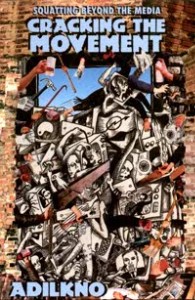
squatting - book - 1994 - Cracking the Movement: Squatting Beyond Media

Cracking the Movement: Squatting Beyond the Media
ADILKNO
Translated by Laura Martz
Autonomedia
1994
239 pages

ADILKNO is a contraction, of sorts, that stands for the Society for the Advancement of Illegal Knowledge.  That this ‘society’ involved three individuals including the currently active Dutch media theorist Geert Lovink, is about as much information as I can dredge up about the group.  Autonomedia has published two books by the society, The Media Archive, a collection of short speculative essays on media that is largely incomprehensible.  I don’t know if its incomprehensible because ADILKNO sought to exceed Jean Baudrillard in his use of obfuscating language and Marshall McLuhan in his willingness to speculate on media forms, or if its incomprehensible because the translation lacks clarity.   

Cracking the Movement: Squatting Beyond the Media is the other ADILKNO book in the Autonomedia catalogue, and like Media Archive, it too suffers from incoherence at parts, likely due to its translation.
Cracking the Movement is an oral history of the squatters movement in Amsterdam during the 1980s.  It describes, from a small number of different points of view, the major events of this movement at this time, albeit sometimes in an excruciatingly detailed fashion. Before summer 2010, when the Dutch government passed anti-squatting laws, taking an unoccupied building space for living purposes was legal provided certain conditions were present.  During the 1980s, according to ADLINKO, there was a huge population of homeless in the Netherlands, and people (many of whom were punks and anarchists) started taking vacant housing for themselves.


From these squats, most notable among them the Groote Keyser, the squatters built up a communities of their own that included squat bars and systems of communication (newspapers and radio).  The squats were both a launchpad for activist movements, and a prescient social issue in themselves.  ADLINKO and their sources discuss how the squats were continually contested terrain under attack from police, landowners, fascist bullies, and rival squatters.  They also discussed the conditions of Amsterdam during this period, such as a mix of poverty and gentrification that encroached upon the working class neighborhoods, and a city blanketed in garbage and dog waste.  The activists from the squats fought against the city’s bid for the 1992 Olympic games, and fought against police after a squatter named Hans Kok died in a police station cell.  The chapters often describe rapid shifts from relaxing and drinking beer to all-out direct action engagement with a social enemy.  

The structure of Cracking the Movement is that of an oral history, in that much of the chapters are made up of transcribed verbal statements given by participants in the events of this squatting movement to the authors (who, by the way, were also participants).  The book’s subtitle is “squatting beyond the media” implying that there was a chronically negative media portrayal of the squatters during the period, and this oral history was a means of asserting their own version of events.  Presumably this is a situation that has not changed, as police and politicians continue to have a friendly relationship with an acritical and unquestioning newsmedia apparatus.

As I have already hinted at in an earlier paragraph, often these oral statements are incredibly detailed, and spare no minor element to a story.  The level of detail presented by this text may be tedious to read, however it gives researchers a strong sense of context for this squatter movement, the people involved in it, and the events that directed its focus.  It is occasionally a difficult text to read, possibly because of the translation from Dutch to English, as the language becomes nonsensical in parts, and incredibly convoluted in others.  I suspect that this is due to the translators wish to preserve the rich detail that exists in the original Dutch text, but any reader of the English version should be mindful of translation issues before dismissing the book.

The full text of Cracking the Movement is available online from a number of sources including at textz.com.

Friday, August 19, 2011

anarchism - article - 2011 - Collective Action, Opacity and the “Problem of Irrationality”: Anarchism and the First of May, 1890-1892

Collective Action, Opacity and the “Problem of Irrationality”: Anarchism and the First of May, 1890-1892
Davide Turcato
Journal for the Study of Radicalism
Vol 5, No 1: 2011
pp. 1-32
Michigan State University Press

Collective Action, Opacity and the “Problem of Irrationality” is the third article I will have annotated from Vol 5, No 1 of the Journal for the Study of Radicalism.  Author Davide Turcato, an independent scholar, challenges an assertion, that anarchist actions are often irrational eruptions, which is commonly expressed in anarchist scholarship.  Turcato suggests that activity that appears as irrational to previous anarchist scholars is likely the result of planning that has occurred out of view. Anarchist planning is often unseen and therefore not a part of in the historical record.  According to Turcato, this gap in the record has produced the stereotype of the irrational anarchist and has lead scholars such as Peter Marshall (who’s attempted to write a comprehensive history of anarchism, Demanding the Impossible) and Eric Hobsbawm (the great Marxist historian who discusses the irrationality of anarchists in his work, Primitive Rebels) to take events as they appear, or to take the word of police or anarchist critics at face value because their words ARE the record.  Like Gabriel,  with his article, Anarchism’s Appeal to German Workers, 1878-1914, and Andrew Cornell with his article, A New Anarchism Emerges, Turcato is inventing new ways of looking at anarchist action and development.  

Turcato is listed by the Journal for the Study of Radicalism as an independent scholar, however he has received a doctorate in History from Simon Frasier University.  He has also earned a Govenor General’s Gold Medal award for his doctorate on Italian anarchism.  Aside from a very strong interest in historical Italian anarchism, Turcato is a language engineer... I don’t really know what a language engineer is, however most of the scholarly articles that appear on his publishing record pertain to the deployment of language by digital technologies.  

Collective Action, Opacity and the “Problem of Irrationality” proceeds from the assumption that social formations that appear to engage in irrational behavior to distant outsiders (such as historians) should rather assume to be operating on their own set of rationale.  Furthermore, drawing from British historian E.P. Thompson’s studies of the 19th century Luddite movement, Turcato classifies 19th century European anarchism as an opaque movement, a social underground, that produced anarchist texts but not necessarily written evidence for specific actions.  

Violent anarchist events from First of May celebrations in France, Italy, and Spain from the years 1890-1892 are used as case studies, by Turcato, to give substance to his new perspective on anarchist history.  Turcato discusses at length these events to speculate on the underlying rationale that drove the spectacular irrationality that other historians have noted.  The author closely investigates the actions of the Italian anarchist leader Errico Malatesta during these years to demonstrate patterns of activity and planning that suggest that events did not spontaneously erupt into violence but were rather crafted insurrections.

Turcato’s article is interesting because, through his study of Malatesta and his interrogation of the existing historical literature, he demonstrates how even historians and thinkers who are sensitive to anarchist politics, such as the Canadian George Woodcock, or the aforementioned Peter Marshall, reinforce the stereotype of the irrational insurrectionist.  It is difficult for me to reconcile Turcato’s newfound rationality in anarchist activity with an understanding of anarchism that has, perhaps, been in part conditioned by the above authors to consider irrationality to be a component of anarchism’s appeal. 

Labels

united states (55) 1990s (25) history (21) 1980s (20) 1960s (19) 2000s (18) 1970s (17) Canada (16) anarchism (15) punk (15) memoir (14) outlaw bikers (14) documentary film (11) civil rights movement (10) new york city (10) film (9) zines (9) 19th century (8) 1950s (7) 20th century (7) black panther party (7) irish republican army (7) 1940s (6) 2010s (6) beats (6) essays (6) hells angels (6) hippies (6) journalism (6) science-fiction (6) street art (6) the troubles (6) England (5) United Kingdom (5) anti-globalization (5) communalism (5) computer hackers (5) exhibition catalog (5) graffiti (5) homeless (5) international (5) labour strike (5) occupy wall street (5) organized labour (5) quebec (5) 1930s (4) France (4) IWW (4) biographical drama (4) dada (4) david graeber (4) drama (4) interviews (4) malcolm x (4) novel (4) provisional IRA (4) psychedelia (4) sncc (4) sociology (4) street gangs (4) surrealism (4) survivalism (4) transcendentalism (4) white nationalism (4) 1920s (3) 4chan (3) BBSs (3) Emma Goldman (3) Europe (3) Karl Marx (3) Texas (3) Toronto (3) anarcho-primitivism (3) anarcho-syndicalism (3) anonymous (3) anthology (3) anti-civilization (3) autobiography (3) banksy (3) comedy (3) critique (3) direct action (3) ethnography (3) football hooligans (3) hacker groups (3) hacking (3) journalistic (3) ku klux klan (3) labour (3) martin luther king jr (3) mongols (3) philosophy (3) radical right (3) reader (3) situationism (3) student movement (3) vagabonds (3) white supremacy (3) william s burroughs (3) /b/ (2) 1910s (2) 1981 Hunger Strikes (2) AFL-CIO (2) Alexander Berkman (2) American South (2) American revolution (2) Andre Breton (2) Arab Spring (2) Australia (2) Baltimore (2) Cromwell (2) English Revolution (2) Fidel Castro (2) Germany (2) Greece (2) Levellers (2) Manchester (2) Marcel Duchamp (2) Max Ernst (2) Mikhail Bakunin (2) Montreal (2) NAACP (2) Peter Kropotkin (2) Portland Oregon (2) Ranters (2) Robin Hood (2) Salvador Dali (2) Southern Poverty Law Center (2) action film (2) animal liberation (2) anti-capitalism (2) anti-war (2) anti-war movements (2) article (2) aryan nations (2) avant-garde (2) bandidos motorcycle club (2) biography (2) black flag (2) black power (2) blek le rat (2) brook farm (2) crime drama (2) critical mass (2) cults (2) cultural criticism (2) david duke (2) design (2) diary (2) dishwasher pete (2) east bay dragons (2) eldridge cleaver (2) environmentalism (2) fan fiction (2) gerry adams (2) historical drama (2) historical survey (2) hobos (2) how to guide (2) indigenous struggle (2) internet memes (2) ireland (2) italy (2) jack kerouac (2) jared taylor (2) john waters (2) john zerzan (2) julian assange (2) keith haring (2) mail art (2) media criticism (2) mohawk warriors (2) mole people (2) murray bookchin (2) musical (2) mysticism (2) nativism (2) new age (2) nomadism (2) northern ireland (2) occupy movement (2) official IRA (2) oka crisis (2) operation black rain (2) oral history (2) paranoia (2) paul goodman (2) philip k dick (2) phone losers of america (2) photobook (2) phreaks (2) piracy (2) posse comitatus (2) prank phone calls (2) primary source (2) revolution (2) sabotage (2) self-publishing (2) shepard fairey (2) spain (2) student protest (2) terrorism (2) the order (2) travel (2) tristan tzara (2) true crime (2) txt files (2) ulrike meinhof (2) underground media (2) unorganized militias (2) 1%ers (1) 17th century (1) 1860s (1) 1900s (1) 1969 (1) 1970 (1) 1972 Bloody Sunday (1) 1980s. memoir (1) 2009 (1) 2011 (1) 2600 Magazine (1) Alberta (1) Alexandros Grigoropoulos (1) Amsterdam (1) Arthur Segal (1) Athens (1) Ben Reitman (1) Bethel (1) Bill Haywood (1) Boston (1) Brad Carter (1) Brendan Hughes (1) British Columbia (1) Burners (1) Burning Man (1) CLASSE (1) Captain Mission (1) Cass Pennant (1) Charles Fourier (1) Chartists (1) Che Guavara (1) Christopher Hill (1) Christopher Street Liberation Day (1) Columbia University (1) DOA (1) Darkthrone (1) David Ervine (1) Dead (1) December 2008 riots (1) Derrick Jensen (1) Dial (1) Diggers (1) Diggers (1650s) (1) Dorothea Tanning (1) Drop City (1) E.D. Nixon (1) East Side White Pride (1) Edward Winterhalder (1) Egypt (1) Emiliano Zapata (1) Emory Douglas (1) Emperor (1) Eric Hobsbawm (1) Eugene V. Debs (1) Exarchia (1) FLQ (1) Factory Records (1) Fenriz (1) French Revolution (1) GLBT rights (1) Gabriel Nadeau-Dubois (1) Gandhi (1) Gay Activist Alliance (1) Geert Lovink (1) George Washington (1) Georges Janco (1) Great Depression (1) Groote Keyser (1) Harlem (1) Haymarket Bombing (1) Henry David Thoreau (1) Henry Rollins (1) Hillel (1) Ho-Chi Minh (1) Hunter S Thompson (1) Hunter S. Thompson (1) Idaho (1) India (1) Indignados (1) Inter City Firm (1) Irish national liberation army (1) Isidore Isou (1) Jack Cade (1) Jeff Ferrell (1) John Humphrey Noyes (1) Joy Division (1) Kemal Ataturk (1) King Alfred (1) Konstantina Kuneva (1) LETS system (1) Labor Party (1) Lenin (1) Leonora Carrington (1) Lettrisme (1) Libertatia (1) Louis Aragorn (1) Luddites (1) Madagascar (1) Mafiaboy (1) Maine (1) Mao Tse-Tung (1) Maple Spring (1) Marcel Janco (1) Margaret Fuller (1) Mark Rudd (1) Martin McGuinnes (1) Mayhem (1) Michigan Milita (1) Moncton (1) Montgomery Bus Boycott (1) Morris Dees (1) Movement Resource Group (1) Mulugeta Seraw (1) National Film Board (1) Ned Kelly (1) Netherlands (1) New Brunswick (1) Norway (1) OK Crackers (1) Occupy Homes (1) Oklahoma (1) Oklehoma (1) Oneida Community (1) Ontario (1) Oscar Wilde (1) Oslo (1) Owen Sound (1) Pagans Motorcycle Club (1) Palestinian nationalism (1) Patrick Henry (1) Paul Eluard (1) People's Kitchen (1) Phalanx Communities (1) Philadelphia (1) Phillipe Soupault (1) Process Church (1) Quakers (1) Randy Weaver (1) Raoul Vaneigem (1) Raymond Pettibon (1) Rene Magritte (1) Robespierre (1) Robiespierre (1) Romania (1) Rome (1) Rosa Parks (1) Rubell Collection (1) Ruby Ridge (1) Russian Revolution (1) Sacco and Vanzetti (1) Samuel Gompers (1) Sinn Fein (1) Situationist International (1) Society for a Democratic Society (1) Sojourners for Truth and Justice (1) Staughton Lynd (1) Surrealists (1) Switzerland (1) T.A.Z. (1) The Rebels (Canada) (1) Thessaloniki (1) Thomas Paine (1) Timothy McVey (1) Tobie Gene Levingston (1) Tom Metzger (1) Toronto Video Activist Collective (1) Tunisia (1) UVF (1) Ulster Volunteer Force (1) Ultras (1) University of Moncton (1) Varg Vikernes (1) WWII (1) Walt Whitman (1) White Citizen's Council (1) Wisconsin (1) Woody Guthrie (1) Workers' Party of Ireland (1) Yes Men (1) Yolanda Lopez (1) Zurich (1) abbie hoffman (1) abolitionism (1) acadian nationalism (1) amana (1) american renaissance (1) anarchist black cross (1) anarcho-communism (1) andreas baader (1) anti-consumerism (1) anti-rent movement (1) arcades (1) arizona (1) art book (1) art history (1) art strike (1) assata shakur (1) atf (1) automatic writing (1) bandidos (1) bandits (1) bartering (1) bay area (1) bertrand russell (1) bicycles (1) biker church (1) bikies (1) black lives matter (1) black metal (1) black radicalism (1) bob black (1) bob flanagan (1) bobby seale (1) bryon gysin (1) business (1) caledonia conflict (1) cats (1) chicago (1) chicago 68 (1) chicago 8 trial (1) children's book (1) chris carlsson (1) chris kraus (1) church of life after shopping (1) church of stop shopping (1) civil disobedience (1) comic book (1) commentary (1) commune (1) communism (1) confidential informants (1) conscientious objectiors (1) contemporary (1) cope2 (1) core (1) correspondence (1) crimethinc ex-workers collective (1) critical race studies. (1) critque (1) crossmaglen (1) cult of the dead cow (1) cultural theory (1) culture jamming (1) cybercrime (1) cycling (1) daniel domscheit-berg (1) david dellinger (1) david watson (1) dead kennedys (1) debbie goad (1) decollage (1) dishwashing (1) donn teal (1) drag (1) drill (1) drugs (1) dumpster diving (1) dwelling portably (1) ed moloney (1) education (1) educational (1) elliot tiber (1) emmet grogan (1) environmental movement (1) errico malatesta (1) fanzines (1) fay stender (1) feminism (1) ferguson (1) folklore (1) front du liberation du quebec (1) gay pride (1) general strike (1) george jackson (1) georges bataille (1) gerard lebovici (1) gnostic (1) graffiti research lab (1) guerrilla filmmaking (1) guide (1) guy debord (1) guy fawkes (1) hakim bey (1) hans kok (1) harmonists (1) hiphop (1) huey newton (1) humour (1) icarians (1) illegal immigration (1) immigration movement (1) independence movement (1) industrial workers of the world (1) inspirationalists (1) insurrection (1) islamophobia (1) jay dobyns (1) jean baudrillard (1) jean-michel basquiat (1) jello biafra (1) jerry adams (1) jerry rubin (1) joe david (1) johann most (1) john birch movement (1) john cage (1) john lewis (1) journal (1) judith sulpine (1) juvenile literature (1) kathy acker (1) keffo (1) ken kesey (1) kenneth rexroth (1) know-nothings (1) lady pink (1) language rights (1) lifestyle anarchism (1) literature (1) london (1) london ont (1) long kesh (1) los angeles (1) manifesto (1) martha cooper (1) marxism (1) masculinity (1) matthew hale (1) max yasgur (1) may day (1) medgar evers (1) merry pranksters (1) mexican mafia (1) michael hart (1) michael lang (1) micro-currency (1) microcosm publishing (1) middle-east (1) mini-series (1) miss van (1) mlk (1) mockumentary (1) mods and rockers (1) moot (1) nation of islam (1) national vanguard (1) native american party (1) neal cassady (1) neo-confederacy (1) neoconservatism (1) neoism (1) new left (1) noam chomsky (1) nolympics (1) non-violence (1) nonsense (1) north africa (1) notes from nowhere (1) obey giant (1) occupy london (1) occupy oakland (1) october crisis (1) oral biography (1) pacifism (1) parecon (1) peasant rebellion (1) perfectionists (1) photomontage (1) pirate radio (1) pirate utopias (1) poachers (1) poetry (1) polemic (1) police brutality (1) political science (1) popular uprisings (1) portland (1) post-WWII (1) prank (1) protest (1) radical art (1) radical left (1) ralph waldo emmerson (1) real IRA (1) red army faction (1) regis debray (1) retort (periodical) (1) reverend billy (1) rock machine (1) ruben "doc" cavazos (1) san francisco (1) scavenging (1) script kiddies (1) scrounging (1) secession (1) second vermont republic (1) self-published (1) semiotext(e) (1) sexual politics (1) shakers (1) shedden massacre (1) short stories (1) simulation (1) slab murphy (1) slave revolt (1) snake mound occupation (1) social ecology (1) socialism (1) solo angeles (1) sonic youth (1) sonny barger (1) south armagh (1) spirituality (1) squatting (1) stage performance (1) stencil graffiti (1) stewart home (1) sticker art (1) stokley charmicael (1) stokley charmichael (1) stonewall riots (1) straight-edge (1) street theater (1) subgenius (1) survey (1) sylvere lotringer (1) tariq ali (1) teacher (1) ted kaczynski (1) television (1) tent city (1) terror (1) thermidor (1) timothy leary (1) train-hopping (1) tramps (1) trickster (1) trolling (1) tunnel dwellers (1) undercover (1) underground press (1) underground railroad (1) uprising (1) urban infrastructure (1) utopian (1) utopian communities (1) vegan (1) vermont (1) war measures act (1) warez scene (1) weather underground (1) white power skinheads (1) why? (newspaper) (1) wikileaks (1) winnipeg (1) woodstock (1) word salad (1) world church of the creator (1) yippies (1) youth culture (1) z communications (1)