Louis Adamic, the author of Dynamite: The Story of Class Violence in America, was not an academically trained historian. He was rather one of the working class intellectuals that Antonio Gramsci theorized in his essay The Formation of the Intellectuals published in the Selections from the Prison Notebooks. That is, an individual who emerged from his or her specific form of class consciousness to act as philosopher from their social situation. Adamic was, as a young man, an unemployed and unskilled worker, a member of the radical Industrial Workers of the World, the international radical labour union, to become a speaker and historian of that movement. He lacked formal education but possessed a will to compile the history of a movement that, in his time, no academic historian was likely to produce. That is, the history of fighting labour in the United States from the mid-19th century through to the 1920s.
Adamic’s history begins with the Molly Maguires, or “Mollies”, a group of ruthlessly aggressive Irish immigrant miners who would kill any mining bosses that created unfavourable conditions. This history then progresses into early wildcat strikes which led to the organization of labour unions. Adamic has a fondness for the more radical unions (such as his own IWW) and opposes them to the more bureaucratic and conservative unions like the American Federation of Labor (AFL) formed under the boss-like cigarmaker Samuel L. Gompers. The heroes of Dynamite are probably Bill Haywood, the brawling Miners Union leader, and Eugene V. Debs, the radical leader of the Industrial Workers of the World, who personally led their rank and file into street battles with police and strikebreakers. Adamic appears to have a fondness, as well, for the users of dynamite, as the statement “Dynamite! That’s the stuff!” appears throughout his text as an affirmation of radical labour’s fighting spirit. Woven into Ademic’s historical narrative of violent labour activity are the stories of anarchists who have taken up the cause, or of related persecution of anarchists of this period, including the episode of Alexander Berkman’s attempted assassination of mine boss Henry Clay Frick, Louis Lingg and the Haymarket Explosion, and the Sacco and Vanzetti trial and execution, which occurred while Ademic was researching and writing this text.
Adamic seems to adore the fighting spirit, even the willingness to use dynamite to advance the interests of working people. Conversely, he speaks with derision of Gomper’s willingness to compromise, negotiate with bosses, which he portrays as the behavior of one who was essentially a career politician. Furthermore, when Adamic speaks of Miner and IWW leader “Big” Bill Haywood’s willingness to leap into combat with only his fists as weapons, he discusses with loathing the AFL’s alliances with Mafia ‘protection’ men, and hired brutes who fought against the bosses’ Pinkerton (for-hire strikebreaking muscle) bullies. Thus Adamic identifies a rift in the American labor movement and firmly priviledges one side over another in his narration of the history of labor-centered violence.
This will be a short profile of a book that has been discussed heavily in other forums since its publication. A People’s History of the United States
is a major work of history, focusing on political oppression in the
United States and the radical social movements that emerged to respond
to such oppression. The book’s author, Howard Zinn, was a social
activist, in addition to an academic, and he spent much of his career
working at Boston University. Zinn had been involved with the American
Civil Rights movement (and one of his best known books is about the
Students Non-Violent Coordinating Committee, an influential Civil Rights
organizations which has been discussed previously on this blog in
relation to John Lewis’ memoir), and later in the anti-war movement during the 1960s, and other social justice movements throughout his life.
A People’s History,
first published in 1980, was a response to all of the books of American
history that focus on the European explorers, founding fathers, and
industrialists who made the United States, bit by bit, into a
superpower. Zinn’s book looks at the social consequences of those
historical stories that have made up the mythology of the United States,
and examines how, historically, common people have been effected by the
actions of America’s elites. Zinn’s story is not just a narrative of
social victims, however, as he heavily emphasizes the radical movements
that emerged to fight political oppression, and each chapter seems to
take a different aspect of this as its focus. In Chapter 9, for
example, Zinn discusses the institution of slavery in the America, but
also the abolition movements that fought against slavery, and even
discussed the details of several specific slave rebellions. Labor
Unions and Anti-War organizing are also persistent themes. This book
demonstrates that this alternative to the dominant telling of American
history has its own heroes.
Some
of the movements discussed by Zinn are virtually lost in most tellings
of American history. Chapter 10 is about the vestigial colonial mode of
land ownership and management in the north during the 19th century and
the Anti-Rent movement
that erupted among agricultural workers who basically fought a war
against land owners in New York state. Zinn’s book also details the
history of the anti-war movement during the Second World War, which is
virtually unheard of in most histories of the period, which generally
take up the line that WWII was the good war. Finally, Zinn’s final
chapter in this 1995 edition is about the first half of the Clinton
years, with a critical analysis of the then current president’s
commitment to progressive values. Zinn published updates and revisions
to this book quite often, and the final edition, published in 2005,
contains a more complete chapter on the 1990s (including discussions of
the Militia Movement, and Mumia Abu Jamal) as well as an analysis of the early Bush II years.
Hello out there on the Internet. I borrowed From the Folks Who Brought You the Weekend: A Short, Illustrated History of Labor in the United States from Robarts Library at the University of Toronto.
From the Folks Who Brought You the Weekend: A Short, Illustrated History of Labor in the United States is a comprehensive yet concise chronicle of American organized labour. The book starts with a description of working conditions for indigenous peoples, slaves, and colonial subjects in the new world, and moves through history ending with discussions of the disparities between workers wages and the salaries of corporate CEOs. The text charts the struggles to maintain labour unions and the perpetual dialectic between workers and management in attempting to negotiate better conditions.
From the Folks Who Brought You the Weekend is a scholarly work by labour historians. Priscilla Murolo is the Co-Director, Graduate Program in Women's History/History at Sarah Lawrence College in Yonkers, New York. Much of Murolo’s work focuses on the labour history of women. A.B. Chitty is a librarian at Queens College of the City University of New York. As the authors' history of American labour moves out of the slave period and into an era where organizations gained strength, the reader (me) can become bogged down by the acronym names of all of the worker’s organizations that formed through the twentieth century. Thankfully the authors included a glossary of acronyms at the beginning of the book although one union can sound like another if you do not keep careful track of how each group entered the text. The book does not have footnotes or citations, but instead has a ‘Suggested Reading’ section near the end, with a list of other scholarly works pertaining to organized labour and the history of work.
There are no photographs or other historical visual materials in Murolo and Chitty’s text. Instead, award winning (American Book Award, Guggenhem Fellowship, Eisner Award) comics artist and writer, Joe Sacco, drew short interludes in comic book format. Sacco's work detailed workplace situations and management attitudes that compelled the workers to organize. Sacco also drew panels illustrating the most common professions of the different phases of American labour history: the pre-industrial, industrial, and post-industrial eras. Sacco’s illustrations are not necessarily scholarly (the ‘boss’ of his illustrations has the same features from comic to comic even if times and settings change) but they provide some relief from reading Murolo and Chitty’s dense text.
Murolo and Chitty’s histroy of American labour unions is comprehensive. The authors detail the initial struggles for unions, often lead by European immigrants who arrived steeped in a radical tradition, to the rise of the radical Industrial Workers of the World that held a prominent position in labour politics through the early part of the twentieth century. The authors also focus quite a bit on the unions that turned into powerful lobbyist bureaucracies, such as the American Federation of Labour, with lawyers for leaders rather than workers. There is a frequent sense that worker’s organizations were sites where fairly normal people would temporarily become radical in their outlook and behavior, however the authors also describe a fair amount of conservatism among organized labour. The authors also focused on the varying attitudes different unions held towards racial integration and the inclusion of women, which were not always progressive. And at certain times and places unions were segregated and the rank and file would occasionally agitate to maintain that status. The authors also identified unions that were willing to look beyond racial prejudice and build on class ties rather than race.
Murolo and Chitty’s text covers much notable successes and failures of organized labour in America. What is missing in their text are accounts of efforts to organize that are thwarted. There were a number of high profile stories from recent years, for example, of the workers at particular McDonalds or Wal Mart locations who attempt to unionize but fail. Their failure occurred either because the workers fear repercussions or because corporate management closes the store, but it is this aspect of labour history that is not found in From The Folks Who Brought You The Weekend. Researchers should rely on this text for the history of workers who successfully organized, and with regards to the history of established labour unions Murolo and Chitty’s book is quite strong.
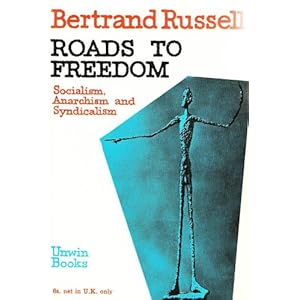
Roads to Freedom: Socialism, Anarchism, and Syndicalism Bertrand Russell Unwin Books 1918/1966 143 pages
Roads to Freedom: Socialism, Anarchism, and Syndicalism was first published in 1918 when the words in his title applied to large scale social movements rather than distant ideologies. It's author speaks of anarchism, syndicalism and socialism in the present tense, and refers to then recent events which are now historic. In 1918 things were happening, syndicalism was popular and the lives of Karl Marx and Mikhail Bakunin had ended not so long ago. The author of Roads to Freedom, Bertrand Russell, was polymath born of an aristocratic family. He held sympathies with socialism, anarchism and syndicalism which he expressed in detail in this slim volume. Russell was an avowed socialist at times in his life, and he occasionally returned to that subject in his writing throughout his career.
The first three chapters of Roads to Freedom comprise a section of the book titled ‘Historical’, which delves into the theories of Socialism (as they were derived from Marx and Engels), anarchism, (as derived from Mikhail Bakunin and Peter Kropotkin) and anarcho-syndicalism. In this text syndicalism appears to be the political philosophy the author is most sympathetic with, as he focused much of his writing on the formation and activities of trade unions, discussing the potential robustness of a society as managed by and for workers. This section of the book finds its author attempting to find the historical origins for the political theories he discusses, delving into the lives of the originating philosophers, as well as summarizing their ideas. Russell, despite his aristocratic roots, poses as advocate for some of these political ideals, particularly socialism and syndicalism.
The second section of the book, ‘Problems of the Future’, is focused on the practical matters of managing societies based around the ideologies of socialism, anarchism or syndicalism. Russell evaluates a number of important social and cultural questions against each set of ideals. Furthermore he interrogates the idealism behind certain aspects of these ideologies. For example he argues against the naive notion, still propounded by contemporary anarchists, that crime is the result of the capitalist system - he argues that many forms of crime will persist and were the world to turn to anarchism, the question would become how to deal with it in a society based on an anti-authoritarian ethos. Furthermore, he asks how are practical matters such as the arts to be supported under these systems, how is the defense of a country possible. He attempts to imagine the pros and cons of how each issue would be dealt with under each ideological system as it stood in the early 20th century. Furthermore, Russell does not simply raise issues but attempts to imagine workable answers to his own queries.
Russell’s book is an impressive analysis of the early 20th century European left. He took the ideologies of the left seriously, and while maintaining a sympathy with the spirit of these political systems he provides a positive critique on the practical matters that these systems would have to face, were they ever implemented as a system for broad social organization. Colin Ward’sAnarchy in Action, a history of the actual implementation of anarchist principles in various times and places, may serve as an interesting companion text for comparison to Russell’s strong analysis.
Elements of Refusal; John Zerzan C.A.L. Press 1999 (originally published in 1988) 308 Pages
John Zerzan is, along with Derrick Jensen and Theodore ‘UNABOM’ Kascynzki, one of the major critics of civilization, and one of the loudest voices to call for its collapse. Zerzan is an anarcho-primitivist, meaning that he advocates a return to primitive ways of life. He is possibly the chief theorist of that branch of anarchist thought, and he has waved his anti-civilization flag since the early 1980s: by writing books and magazine columns/articles, a weekly radio show (Anarchy Radio on KWVA 88.1 in Eugene, OR) and maintaining an extensive speaking schedule. Elements of Refusal was Zerzan’s first book. It was also one of the earliest books to carry an anti-civilization philosophy, and is perhaps one of the strongest collections of essays to advance such an idea.
Elements of Refusal is an anthology of Zerzan’s essays (some of which were also published in Adam Parfrey’s anthology of ‘forbidden knowledge’ titled Apocalypse Culture, some were published in far-left journals such as the Fifth Estate and Anarchy:A Journal of Desire Armed). Some of Zerzan’s books primarily focus on the benefits of a primitive/paleolithic lifestyle, however Elements is more a negative critique of contemporary western civilization. Zerzan identified a series of cultural forms as the foundations of human subjugation and investigates how they arose to form the edifice of civilization. The first part of the collection focuses on numbers (and mathematics), agriculture, and art; the basis of scientific practice, sedent human habitation and symbolic thought. The second part of Elements collection focuses on relatively recent issues of labour and industrialization. The third part focuses on the period during which Zerzan was writing these pieces, particularly the 1980s. In this third part Zerzan describes western civilization as a world that is accelerating towards a painful collapse.
The most common criticism levelled against the Canadian philosopher Marshall McLuhan has been that he is a technological determinist. This means that, according to Marshall McLuhan’s critics, McLuhan’s analysis of the use of media technology over the centuries amounts to describing how humans and societies are formed by such technology. Zerzan may be considered a technological determinist to an extreme, in that his anti-civilization theories chart a course between a cultural tool, the invention of numbers, for example, and a nightmarish view of western civilization. McLuhan’s theories were often connections between the adoption of a new medium or technology, and some cultural shift. Many of his theories are based upon quotations drawn from secondary sources, and many of his theories were purely speculative. Somewhat similarly, Zerzan’s strategy is to find a series of historical steps by which he can advance his idea. Through the genealogy Zerzan constructs for his object of study, he finds that their contribution to the rise of civilization as a contemporary apparatus for control was never an accident. The forms he discusses, such as agriculture or numbers, never took a wrong turn somewhere in their history. Actually, they were inevitably leading towards the modern world Zerzan loathes. Hence my consideration of Zerzan as a technological determinist to the absolute limit. Zerzan’s unspoken solution (unspoken in this text) is to return to the pre-numbers, pre-agriculture, pre-art world of the paleolithic.
Interestingly, in Zerzan’s preface to my copy, the second edition of Elements of Refusal, he ends the brief piece with a statement refuting Hakim Bey’s charge that he has had once written an essay against humour. I have read Bey’s Millennium, the text in which this essay is originally mentioned, and before reading Zerzan’s preface I was positive I had read this essay. It turns out that it does not exist and Zerzan’s ontological anarchist rival, Bey, invented it, probably to poke fun at the primitivist philosopher. Still, Elements of Refusal is an excellent primary source for anyone seeking research materials on anti-civilization thought, or a number of other countercultural fields of study.