Showing posts with label homeless. Show all posts

Friday, November 23, 2012

vagabondia - film - 2000 - Dark Days

Dark Days
Marc Singer
Picture Farm
2000
94 minutes

Dark Days is a black and white documentary that covers the same subject matter as Jennifer Toth’s The Mole People and Margaret Morton’s The Tunnel, the subterranean tunnel dwellers of New York City. The film is the sole documentary by filmmaker Marc Singer, and has won a number of ‘best documentary’ awards in the year of its release.

Singer’s documentary is essentially a film version of the above mentioned books. The Mole People is a flawed work of journalism, The Tunnel is primarily a book of black and white photos, and Dark Days is a step further than the two, providing a deep investigation into the lives of the people who live under the NYC streets that validates aspects of Toth’s scrutinized text (although not the most outlandish aspects, such as stories of an underground citadel beneath grand central station), and with its black-and-white aesthetic, provides the dimension of time to Morton’s photographic work.  All this is set to a musical score composed by DJ Shadow.

What’s notable about Singer’s film is the sense of society, in tension with a sense of individual isolation, in that, while it shows the men living in solitude under conditions of 24-hour darkness, the film also displays a number of friendships between these people. The film also partially displays an economy of scavenging and the sale of found objects, an essentially social activity.
The film is also important for showing the resourcefulness of the tunnel-dwellers and their ability to find novel ways to fulfill the necessities of life.


Thursday, June 23, 2011

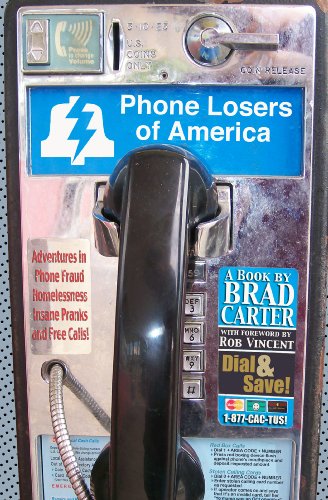
computer hackers - book - 2010 - Phone Losers of America

Phone Losers of America
Brad Carter
Big Beef Bueno Books
2010
297 pages

This book is part of a trend of 1980s/90s hack/phreak textfile groups who are printing anthologies or memoirs of their histories.  In 2006 the Cult of the Dead Cow published The Book of Cao, an anthology of their txt files, while 2600 magazine (which has always a print magazine rather than a t-phile group) has published a ‘best of’ anthology in addition to an anthology of letters sent by readers titled Dear Hacker.  Phone Losers of America is different from these other books in that it is a memoir, rather than an anthology, of Brad Carter (aka RedBoxChilliPepper) and his phone/hacker related pranks and adventures.

    Brad Carter is the spiritual figurehead of the Phone Losers of America, otherwise referred to as the PLA.  The PLA can be interpreted as a loose confederation of telephone prankster hackers who use www.phonelosers.org and its discussion forums as their headquarters.  The PLA can also be thought of as Brad Carter and his friends, and the PLA mission may include anything amusing that they do.  In addition to authoring this book, and editing (as well as writing, for the most part) 46 PLA .txt files, Carter also sporadically releases episodes of two different podcasts: PLA Radio, and Big Beef Bueno Podcast, and hosts the prank call focused radio program, The Phone Show.  Carter’s activities are significant in the hacker world in that he and his associates eschew the white-grey hat hacker ethical pretensions in favour of exploiting the new frontier of network telecommunications as a vast forum for pranks and obnoxious behavior.  

Carter’s text is divided into 23 chapters of varying formats.  The PLA are known for embellishing their texts with dramatic or comedic flourish, and while Carter presents his book as a memoir, it begins with a brief bit of fiction about himself (named Alex in the text) and a friend. The pair were dumpster diving at a local telco office one night when a garbage truck picked up a dumpster while his friend was hiding in it.  Alex fled town, believing that his friend, Doug, had died, and in flight his PLA adventures began.  Following this opening, the each of the subsequent chapters (with some deviation) delve into a particular prank that Carter has pulled, either by himself or with accomplices.  Some chapters recall the targetting of a particularly notable rube, some of whom are familiar to follwers of PLA forums or radio.  Many of the chapters are re-written PLA text files detailing phonehijinks with cordless phones and other things, but some are escapades from after the text-file era, for example Carter’s replacement of a sign on a lawn of a McDonalds.  Carter painstakingly mimiced the logo and the format of a sign that read “Our Team is Empowered to Guarantee Your Satisfaction” to instead read “Our Team is Well Endowed to Guarantee Your Pleasure”.  This episode is unique in that it did not directly involve the internet or telephone in any way, but it is the sort of adventure Carter devoted much of his time to.

Many of Carter’s chapters detail activities that were meant to amuse.  In the chapter titled 'eBay Feedback', for example, Carter notes that he has been a frequent user of eBay for many years, and that at some point he decided to play with the comments section.  Carter would leave strange or silly comments on another sellers profile, with regards to a purchase, while leaving their seller rating intact.  While this is an internet based prank, rather than telephone based, it reminds me of something I read about the legality of prank phone calls.  I’ve read that the reason no one has ever been convicted of making prank phone calls is because making a call for the purposing of amusing the callee fits within the bounds of correct telephone use.  

Travel is another theme of Phone Losers of America.  Carter moved frequently around the United States, and as he described in a chapter titled ‘Homelessness’, he occasionally lived without a home and instead lived in bus stations or his vehicle.  In addition to this, Carter described (in a chapter that I’m not sure is fiction or not) acquiring free air-travel within the united states via credit card fraud.  Carter’s textual identity is certainly unstable, but he positions himself as alternating between jet-set fraudster, and nihilistic vagabond prankster.  

    Phone Losers of America is interesting because it embraces an aspect of the computer underground that is unacknowledged by most books about hackers.  That is the potential for fun and mischief that a dominant reliance on computer technology has opened.  Unlike Michael Calce in Mafiaboy, Brad Carter does not present Alex as interested in showing off his technological prowess or driven for the hidden knowledge that lies somewhere beyond a password prompt.  Alex appears to be motivated by a desire to laugh at the anger of others.  He he disregards emerging forms of etiquette and directs most of his technological knowledge towards achieve this. 

Wednesday, June 22, 2011

vagabondia - book - 2009 - Dwelling Portably: 1990-1999

Dwelling Portably: 1990-1999
Bert and Holly Davis
Microcosm Publishing
2009
164 pages


This book is one of three volumes that anthologize the Message Post/Dwelling Portably print newsletter.  MP/DP is a handmade publication full of practical lifestyle tips for people who ‘dwell portably’, or in otherwords, live without a house.  The publication has run since 1980, and continues to be published by the Davises for the benefit of a loose community of proactively homeless people.  This post pertains to the second volume which contains all of the issues of the newsletter published between February 1990 and ending in November 1999.  

The book contains no introduction, or afterword, or table of contents.  The book is simply the content of the newsletters, as they originally appeared (presumably), with an index at the back to help the reader find needed tips.  All of the text is written in courier typeface and all of the images are hand-drawn diagrams or illustrations.  Each newsletter appears exactly like it would have, with a unique heading, subscription/contact information, and a publication date.  The individual newsletters vary in length, from 2 to 10 pages.  The editors of the newsletter are Bert and Holly Davis, presumably a couple who live an ascetic lifestyle.  Much of the content is submitted by others who live similar lifestyles and wish to share their tips, with occasional tips or responses to submissions written by Bert and/or Holly Davis.  Some items are taken from camping magazines or other related publications.

Dwelling Portably is interesting for a number of reasons.  The publication points to a community of people who desire homelessness and share tips on how to thrive without a house or many of the amenities offered by post-industrial consumer society.  Bert and Holly, I think, live in a yurt, while many of their submissions come from people who live in cars or busses, in small tents with bicycles, in tree-shelters, or any number of variations.  Also many of the entries contain practical information about tools, cooking, bedding, insulation, transportation, and re-purposing found materials for this kind of lifestyle.  Many other entries deal with things like how to discourage potential assailants, how to deal with police who do not understand such lifestyles, etc.  The entries I, personally found to be most interesting, were those that contained detailed descriptions for how such lives are lived.  Many submitters described renovated old buses or vans for living (which recalls Dishwasher Pete’s description of his renovated van) some travelled on bicycle with a small tent with them and one man described life while travelling on horseback.  These entries were not necessarily meant as lifestyle tips but perhaps rather as indications of possibility.

Some messages are very short and are requests for information on how to live a certain lifestyle that relates to the theme of ‘dwelling portably’.  Someone may write stating that they would like information on how to live on a boat, or how to ride the rails successfully (see Ted Conover, Rolling Nowhere) for example.  The inclusion of such requests suggests that the Message Post/Dwelling Portably newsletter is a chief point of connection between the people who live this way.  

One interesting implication of Dwelling Portably is that the publication presents an alternative form of survivalism to the more apocalyptic second-amendment obsessed ultra-right wing milieu that the term usually applies to.  When attitudes are expressed, Dwelling Portably is upbeat about light living, and otherwise the newsletter simply wants to provide some helpful tips.  The publication is by and for people who already live survivalist lifestyles, and it does not need to declare that it is necessary to know this stuff in order to weather an impending Armageddon.  The people who ‘dwell portably’ and contribute to the newsletter approach their lifestyle with more of a 1960s ‘drop-out’ attitude.  They aren’t preparing for war or catastrophic scarcity, they have chosen such a lifestyle because it suits them.  

Dwelling Portably: 1990-1999 is the middle of three volumes of collected newsletters.  I suspect that the other two are similar in format, although I am curious about the practical matters of publishing the newsletter itself and I hope that one of the other books contains such information.  Bert and Holly speak about their own circumstances occasionally, although usually in response to an idea another writer had, or to address a practical issue such as bathing or waste disposal.  They move occasionally and the inside of the book’s back cover contains an email address from which a reader may receive their mailing address.  I would like to know how they manage publishing a newsletter themselves while they move, and sending it to a readership who may, in part at least, do the same. 

Tuesday, June 21, 2011

vagabondia - book - 1993 - The Mole People: Life in the Tunnels Beneath New York City

The Mole People: Life in the Tunnels Beneath New York City
Jennifer Toth
Chicago Review Press
1993
267 pages


Hello out there in Interville!  I purchased The Mole People: Life in the Tunnels Beneath New York City, from Seekers Books, located on the corner of Bloor st. West and Borden st. in the Annex neighborhood of Toronto.

The Mole People: Life in the Tunnels beneath New York City, is the best known work by journalist Jennifer Toth.  The text is intended as a journalistic account of the homeless people who live in makeshift communities in the underground infrastructure of New York City.  Toth creates an uneven view of the people who live there without clearly delineating them as a unique population within the larger group that is the city’s homeless.  The various chapters of her book are defined by encounters with particular individuals.  Chapter two, for example, is called “Seville’s Story”, wherein Toth discussed the situation of a particular man, while other chapters cover more broad aspects of the underground population.  Another example, chapter 22, “Women”, is broken up into short stories separated under headings of the first names of a number of women with whom Toth spoke.  

Aspects of the text are interesting, especially those parts where Toth describes the methods used by the underground dwellers for acquiring resources, or the living arrangements of particular individuals.  Much of the book appears as brief and superficial newspaper pieces about particular encounters with tunnel inhabitants.  This style of writing is especially emphasized when she introduces an individual a second time in the text, as she does with officer Bryan Henry, who appears early in the text and again towards its end.  Otherwise much of the book describes a number of encounters with the underground homeless without adding any new insights into the experience of being homeless, or of the unique nature of underground living.

Furthermore, a number of aspects of tunnel life that a reader may infer exist are merely alluded to, and never witnessed by Toth. There seems to be an issue with these kinds of texts where an author attempts to enter into a marginal social world.  The author appears to become a privileged outsider.  Toth is given access to components of the tunnel communities but is also shielded from their harsher aspects.  Violence, for example, is repeatedly referred to, by the discovery of a body, mentioned early in the book, and in conversation with a number of the tunnel dwellers.  Toth, however, never witnesses anything.  Something similar appears to be at play in Ted Conover’s Rolling Nowhere, however Conover dedicated himself to living the hobo lifestyle for a matter of months, and he witnessed violence, he just was never afflicted by it. (sidenote: Conover and Toth’s books both contain descriptions of violence by youths on the vulnerable poor).  Towards the end of the text, Toth is threatened by a tunnel dweller she thought she had befriended because he believed that she witnessed a murder he committed.  This situation, although quite serious for Toth at the time, approached an absurd horizon, as it created the implication that there’s a continuum of brutal behavior beneath these streets and her only encounter with it was a misunderstanding.

Toth’s book is an interesting introduction to this subject matter, however the potentially most interesting aspects seem to lie beyond its boundaries.  Many of the tunnel dwellers speak of having been aware of the underground communities before they actually entered it - that people were aware that beneath the surface there were hidden eyes - but she never speaks to members of the above ground population for thoughts on the people that lurk within their city infrastructure.  Furthermore, as a privileged outsider, Toth speaks with people who are, undoubtedly, the most extroverted members of a secretive population.  One individual named J.C. in the text says that a number of the people will only speak with social workers, however, Toth never speaks with social workers about the tunnel dwellers except to source statistics.   Nor does Toth ever discuss the tunnel dwellers as a part of an overall analysis of homelessness in the city.  

The effect created by these lacks is that the tunnel dwellers are almost formed into zoo animals by the text.  They are observed briefly as curiosities, but not entirely taken seriously as meaning anything to the larger social environment.  Perhaps a partial strategy for reporting on an underground population is that a reader may be lead to interpret the tunnel dwellers as mutually distinct from the aboveground population, and not place demands on the text to connect the two realms.  Many of the personal stories of Mole People, told to Toth, describe a desire to leave society.  While those individuals may be sincere in the desires they express, and their social status certainly must change when they move into the tunnels (even if they were socially marginal in the first place), they are still a part of society.

Despite these criticisms, The Mole People is still an interesting text that shines a light onto a marginal population that is beyond the beyond as far as the public’s ability to perceive it is concerned.  I’m aware that Joseph Brennan, a NYC subway enthusiast, has written a lengthy piece on how inaccurate Toth’s descriptions of the underground locations are.  I don’t really think that that is a particularly relevant aspect of her text.  Exact locations of tunnel spots are not important, and what is important about the text is that it describes a group of people’s will to repurpose the subterranean urban infrastructure for the sake of survival and even community.   

Monday, June 6, 2011

vagabondia - book - 1984 - Rolling Nowhere: Riding the Rails with America’s Hoboes

Rolling Nowhere: Riding the Rails with America’s Hoboes
Ted Conover
1984
Viking Press
274 Pages


Hey out there in computer world!  I borrowed Rolling Nowhere: Riding the Rails with America’s Hoboes from Robarts Library at the University of Toronto.

Rolling Nowhere is the first book by Ted Conover, an investigative journalist who has made a career out of immersing himself in the social world he intends to take as his subject matter. Conover wrote this text while he was still a student at Amherst College.  Inspired by his anthropology classes, he decided to embark on an adventure of social as well as geographical exploration, as he traveled the America by train, posing as a member of the hobo underclass.  Through his travels, Conover finds that in the early 1980s people with meager means of support still resort to hopping freight trains as a means for transportation and survival.

Rolling Nowhere is a story of Conover’s entry into, and participation in, the lifestyle of the travelling hobo over the period of several months in the early 1980s.  Much of his text notes Conover’s feelings and thoughts about what he is doing, his determination to go through with his plans despite his fears, his desire to speak with his family or the acknowledgment that his behaviors and attitudes are being changed by his adventure.   Much of the text is also descriptions of the people he meets or the experiences he has with them, however Conover’s self-transformation is really the subject of his book.

The text begins with the author’s naive efforts to catch out for the very first time, as he simply headed to the train-tracks one night to try to find a train to hop.  He quickly found Leroy after his travels began, who gave the author a quick education in the dynamics of train hopping and tramp living.  From that point on, Conover, lived among the hobos, riding trains with them, eating at missions and sleeping at Hobo jungles.  He began to smoke and drink with the men (and one woman) he met, and witnessed their forms of behavior directly.  

The persistent themes of Conover’s book are violence, scarcity, addiction, and isolation.   Conover witnessed pointless violence between the hobos, however he also witnessed the hobos victimized by people, particularly children and adolescents whom he said “attacked the only kind of grown up they could get away with attacking.”  Real accounts of such attacks have made headlines in recent months and are probably an ever-present possibility for the vulnerable poor.  Conover acknowledged that many hobos have fallen outside of society due to  trauma in their past, and often nurture an assortment of critical personal issues that make it difficult for them to reintegrate into society.  He observed hobos as people who are socially detached from one another, even when they appear to be engaged in friendships. Conover noted that the men who ride the rails are prepared to separate without sentiment at any moment, or worse, turn violently on one another over matters that may seem trivial.

Conover ascertained that while the train moving, the hobo is safe.  Danger looms when the train approaches its destination, as rail security, police, and potentially worst of all, other hobos, may be present at the stop.  Conover recalls a few close calls between himself and other hobos, and he describes some scenes of hobo on hobo brutality, however for the most part he avoided engaging in violence himself.  A single cruel act is committed by the author when he realizes a hobo was trying to enter his boxcar while the train was moving.  Conover insisted that to enter an occupied boxcar without asking its occupant is poor hobo etiquette, and when an invader grabbed hold of his car, Conover stomped on his fingers to force him to release his grip.  This one scene is shocking and almost creates a sense that Conover has crossed a boundary set by his middle class values, into the moral realm of the career hobo.  

While I was reading Rolling Nowhere I was expecting the text to end with some kind of stomping, like the sort Hunter S. Thompson described himself receiving at the hands of the Hells Angels in the epilogue to his account of the motorcycle club.  Instead, towards the end of Conover’s text, he described narrowly escaped the light of a police officer, probing the boxcar he was hiding in in Tulsa.  Conover described Tulsa as a “hot” town, where the police were intensely active in the search of illicit train passengers.  Conover then rests under an overpass and creates a sense of dread through his reflections upon all of the threats a hobo has to be concerned with, and expresses a profound lethargy over this constant worry.  He thus extends this dread to a kind of sympathy with the real hobos who did not share in his luxury to return home when they felt the adventure was over.  This feeling of dread Conover develops is palpable, however, and is perhaps as profound a means of conveying the danger of the depicted lifestyle as Thompson’s final experience of brutality at the hands of the notorious bikers.

    Rolling Nowhere describes the sincere effort made by a middle class young man to enter a social realm occupied by desperate and often dangerous men.  Conover lived as closely to the ideal hobo lifestyle as possible, without betraying his origins to any of the people he met on the road.  People came to respond to him as a fellow traveler, and he appeared to develop an insightful understanding of hobo society.  His reflections on the ways of living and methods for survival adopted by the train-hoppers he met are interesting enough that they should be acknowledged by researchers of this subject matter.

Labels

united states (55) 1990s (25) history (21) 1980s (20) 1960s (19) 2000s (18) 1970s (17) Canada (16) anarchism (15) punk (15) memoir (14) outlaw bikers (14) documentary film (11) civil rights movement (10) new york city (10) film (9) zines (9) 19th century (8) 1950s (7) 20th century (7) black panther party (7) irish republican army (7) 1940s (6) 2010s (6) beats (6) essays (6) hells angels (6) hippies (6) journalism (6) science-fiction (6) street art (6) the troubles (6) England (5) United Kingdom (5) anti-globalization (5) communalism (5) computer hackers (5) exhibition catalog (5) graffiti (5) homeless (5) international (5) labour strike (5) occupy wall street (5) organized labour (5) quebec (5) 1930s (4) France (4) IWW (4) biographical drama (4) dada (4) david graeber (4) drama (4) interviews (4) malcolm x (4) novel (4) provisional IRA (4) psychedelia (4) sncc (4) sociology (4) street gangs (4) surrealism (4) survivalism (4) transcendentalism (4) white nationalism (4) 1920s (3) 4chan (3) BBSs (3) Emma Goldman (3) Europe (3) Karl Marx (3) Texas (3) Toronto (3) anarcho-primitivism (3) anarcho-syndicalism (3) anonymous (3) anthology (3) anti-civilization (3) autobiography (3) banksy (3) comedy (3) critique (3) direct action (3) ethnography (3) football hooligans (3) hacker groups (3) hacking (3) journalistic (3) ku klux klan (3) labour (3) martin luther king jr (3) mongols (3) philosophy (3) radical right (3) reader (3) situationism (3) student movement (3) vagabonds (3) white supremacy (3) william s burroughs (3) /b/ (2) 1910s (2) 1981 Hunger Strikes (2) AFL-CIO (2) Alexander Berkman (2) American South (2) American revolution (2) Andre Breton (2) Arab Spring (2) Australia (2) Baltimore (2) Cromwell (2) English Revolution (2) Fidel Castro (2) Germany (2) Greece (2) Levellers (2) Manchester (2) Marcel Duchamp (2) Max Ernst (2) Mikhail Bakunin (2) Montreal (2) NAACP (2) Peter Kropotkin (2) Portland Oregon (2) Ranters (2) Robin Hood (2) Salvador Dali (2) Southern Poverty Law Center (2) action film (2) animal liberation (2) anti-capitalism (2) anti-war (2) anti-war movements (2) article (2) aryan nations (2) avant-garde (2) bandidos motorcycle club (2) biography (2) black flag (2) black power (2) blek le rat (2) brook farm (2) crime drama (2) critical mass (2) cults (2) cultural criticism (2) david duke (2) design (2) diary (2) dishwasher pete (2) east bay dragons (2) eldridge cleaver (2) environmentalism (2) fan fiction (2) gerry adams (2) historical drama (2) historical survey (2) hobos (2) how to guide (2) indigenous struggle (2) internet memes (2) ireland (2) italy (2) jack kerouac (2) jared taylor (2) john waters (2) john zerzan (2) julian assange (2) keith haring (2) mail art (2) media criticism (2) mohawk warriors (2) mole people (2) murray bookchin (2) musical (2) mysticism (2) nativism (2) new age (2) nomadism (2) northern ireland (2) occupy movement (2) official IRA (2) oka crisis (2) operation black rain (2) oral history (2) paranoia (2) paul goodman (2) philip k dick (2) phone losers of america (2) photobook (2) phreaks (2) piracy (2) posse comitatus (2) prank phone calls (2) primary source (2) revolution (2) sabotage (2) self-publishing (2) shepard fairey (2) spain (2) student protest (2) terrorism (2) the order (2) travel (2) tristan tzara (2) true crime (2) txt files (2) ulrike meinhof (2) underground media (2) unorganized militias (2) 1%ers (1) 17th century (1) 1860s (1) 1900s (1) 1969 (1) 1970 (1) 1972 Bloody Sunday (1) 1980s. memoir (1) 2009 (1) 2011 (1) 2600 Magazine (1) Alberta (1) Alexandros Grigoropoulos (1) Amsterdam (1) Arthur Segal (1) Athens (1) Ben Reitman (1) Bethel (1) Bill Haywood (1) Boston (1) Brad Carter (1) Brendan Hughes (1) British Columbia (1) Burners (1) Burning Man (1) CLASSE (1) Captain Mission (1) Cass Pennant (1) Charles Fourier (1) Chartists (1) Che Guavara (1) Christopher Hill (1) Christopher Street Liberation Day (1) Columbia University (1) DOA (1) Darkthrone (1) David Ervine (1) Dead (1) December 2008 riots (1) Derrick Jensen (1) Dial (1) Diggers (1) Diggers (1650s) (1) Dorothea Tanning (1) Drop City (1) E.D. Nixon (1) East Side White Pride (1) Edward Winterhalder (1) Egypt (1) Emiliano Zapata (1) Emory Douglas (1) Emperor (1) Eric Hobsbawm (1) Eugene V. Debs (1) Exarchia (1) FLQ (1) Factory Records (1) Fenriz (1) French Revolution (1) GLBT rights (1) Gabriel Nadeau-Dubois (1) Gandhi (1) Gay Activist Alliance (1) Geert Lovink (1) George Washington (1) Georges Janco (1) Great Depression (1) Groote Keyser (1) Harlem (1) Haymarket Bombing (1) Henry David Thoreau (1) Henry Rollins (1) Hillel (1) Ho-Chi Minh (1) Hunter S Thompson (1) Hunter S. Thompson (1) Idaho (1) India (1) Indignados (1) Inter City Firm (1) Irish national liberation army (1) Isidore Isou (1) Jack Cade (1) Jeff Ferrell (1) John Humphrey Noyes (1) Joy Division (1) Kemal Ataturk (1) King Alfred (1) Konstantina Kuneva (1) LETS system (1) Labor Party (1) Lenin (1) Leonora Carrington (1) Lettrisme (1) Libertatia (1) Louis Aragorn (1) Luddites (1) Madagascar (1) Mafiaboy (1) Maine (1) Mao Tse-Tung (1) Maple Spring (1) Marcel Janco (1) Margaret Fuller (1) Mark Rudd (1) Martin McGuinnes (1) Mayhem (1) Michigan Milita (1) Moncton (1) Montgomery Bus Boycott (1) Morris Dees (1) Movement Resource Group (1) Mulugeta Seraw (1) National Film Board (1) Ned Kelly (1) Netherlands (1) New Brunswick (1) Norway (1) OK Crackers (1) Occupy Homes (1) Oklahoma (1) Oklehoma (1) Oneida Community (1) Ontario (1) Oscar Wilde (1) Oslo (1) Owen Sound (1) Pagans Motorcycle Club (1) Palestinian nationalism (1) Patrick Henry (1) Paul Eluard (1) People's Kitchen (1) Phalanx Communities (1) Philadelphia (1) Phillipe Soupault (1) Process Church (1) Quakers (1) Randy Weaver (1) Raoul Vaneigem (1) Raymond Pettibon (1) Rene Magritte (1) Robespierre (1) Robiespierre (1) Romania (1) Rome (1) Rosa Parks (1) Rubell Collection (1) Ruby Ridge (1) Russian Revolution (1) Sacco and Vanzetti (1) Samuel Gompers (1) Sinn Fein (1) Situationist International (1) Society for a Democratic Society (1) Sojourners for Truth and Justice (1) Staughton Lynd (1) Surrealists (1) Switzerland (1) T.A.Z. (1) The Rebels (Canada) (1) Thessaloniki (1) Thomas Paine (1) Timothy McVey (1) Tobie Gene Levingston (1) Tom Metzger (1) Toronto Video Activist Collective (1) Tunisia (1) UVF (1) Ulster Volunteer Force (1) Ultras (1) University of Moncton (1) Varg Vikernes (1) WWII (1) Walt Whitman (1) White Citizen's Council (1) Wisconsin (1) Woody Guthrie (1) Workers' Party of Ireland (1) Yes Men (1) Yolanda Lopez (1) Zurich (1) abbie hoffman (1) abolitionism (1) acadian nationalism (1) amana (1) american renaissance (1) anarchist black cross (1) anarcho-communism (1) andreas baader (1) anti-consumerism (1) anti-rent movement (1) arcades (1) arizona (1) art book (1) art history (1) art strike (1) assata shakur (1) atf (1) automatic writing (1) bandidos (1) bandits (1) bartering (1) bay area (1) bertrand russell (1) bicycles (1) biker church (1) bikies (1) black lives matter (1) black metal (1) black radicalism (1) bob black (1) bob flanagan (1) bobby seale (1) bryon gysin (1) business (1) caledonia conflict (1) cats (1) chicago (1) chicago 68 (1) chicago 8 trial (1) children's book (1) chris carlsson (1) chris kraus (1) church of life after shopping (1) church of stop shopping (1) civil disobedience (1) comic book (1) commentary (1) commune (1) communism (1) confidential informants (1) conscientious objectiors (1) contemporary (1) cope2 (1) core (1) correspondence (1) crimethinc ex-workers collective (1) critical race studies. (1) critque (1) crossmaglen (1) cult of the dead cow (1) cultural theory (1) culture jamming (1) cybercrime (1) cycling (1) daniel domscheit-berg (1) david dellinger (1) david watson (1) dead kennedys (1) debbie goad (1) decollage (1) dishwashing (1) donn teal (1) drag (1) drill (1) drugs (1) dumpster diving (1) dwelling portably (1) ed moloney (1) education (1) educational (1) elliot tiber (1) emmet grogan (1) environmental movement (1) errico malatesta (1) fanzines (1) fay stender (1) feminism (1) ferguson (1) folklore (1) front du liberation du quebec (1) gay pride (1) general strike (1) george jackson (1) georges bataille (1) gerard lebovici (1) gnostic (1) graffiti research lab (1) guerrilla filmmaking (1) guide (1) guy debord (1) guy fawkes (1) hakim bey (1) hans kok (1) harmonists (1) hiphop (1) huey newton (1) humour (1) icarians (1) illegal immigration (1) immigration movement (1) independence movement (1) industrial workers of the world (1) inspirationalists (1) insurrection (1) islamophobia (1) jay dobyns (1) jean baudrillard (1) jean-michel basquiat (1) jello biafra (1) jerry adams (1) jerry rubin (1) joe david (1) johann most (1) john birch movement (1) john cage (1) john lewis (1) journal (1) judith sulpine (1) juvenile literature (1) kathy acker (1) keffo (1) ken kesey (1) kenneth rexroth (1) know-nothings (1) lady pink (1) language rights (1) lifestyle anarchism (1) literature (1) london (1) london ont (1) long kesh (1) los angeles (1) manifesto (1) martha cooper (1) marxism (1) masculinity (1) matthew hale (1) max yasgur (1) may day (1) medgar evers (1) merry pranksters (1) mexican mafia (1) michael hart (1) michael lang (1) micro-currency (1) microcosm publishing (1) middle-east (1) mini-series (1) miss van (1) mlk (1) mockumentary (1) mods and rockers (1) moot (1) nation of islam (1) national vanguard (1) native american party (1) neal cassady (1) neo-confederacy (1) neoconservatism (1) neoism (1) new left (1) noam chomsky (1) nolympics (1) non-violence (1) nonsense (1) north africa (1) notes from nowhere (1) obey giant (1) occupy london (1) occupy oakland (1) october crisis (1) oral biography (1) pacifism (1) parecon (1) peasant rebellion (1) perfectionists (1) photomontage (1) pirate radio (1) pirate utopias (1) poachers (1) poetry (1) polemic (1) police brutality (1) political science (1) popular uprisings (1) portland (1) post-WWII (1) prank (1) protest (1) radical art (1) radical left (1) ralph waldo emmerson (1) real IRA (1) red army faction (1) regis debray (1) retort (periodical) (1) reverend billy (1) rock machine (1) ruben "doc" cavazos (1) san francisco (1) scavenging (1) script kiddies (1) scrounging (1) secession (1) second vermont republic (1) self-published (1) semiotext(e) (1) sexual politics (1) shakers (1) shedden massacre (1) short stories (1) simulation (1) slab murphy (1) slave revolt (1) snake mound occupation (1) social ecology (1) socialism (1) solo angeles (1) sonic youth (1) sonny barger (1) south armagh (1) spirituality (1) squatting (1) stage performance (1) stencil graffiti (1) stewart home (1) sticker art (1) stokley charmicael (1) stokley charmichael (1) stonewall riots (1) straight-edge (1) street theater (1) subgenius (1) survey (1) sylvere lotringer (1) tariq ali (1) teacher (1) ted kaczynski (1) television (1) tent city (1) terror (1) thermidor (1) timothy leary (1) train-hopping (1) tramps (1) trickster (1) trolling (1) tunnel dwellers (1) undercover (1) underground press (1) underground railroad (1) uprising (1) urban infrastructure (1) utopian (1) utopian communities (1) vegan (1) vermont (1) war measures act (1) warez scene (1) weather underground (1) white power skinheads (1) why? (newspaper) (1) wikileaks (1) winnipeg (1) woodstock (1) word salad (1) world church of the creator (1) yippies (1) youth culture (1) z communications (1)