Revolutionaries: Agents of Change James Haskins J.B. Lippincott Company 1971 224 pages
I borrowed this book from the Toronto Public Library. It’s author, James Haskins, wrote many books over his career (which ended with his death in 2005), many of them focusing on African American culture and achievement, and many of his books are meant to be read by adolescent readers. Revolutionaries: Agents of Change, is one of the books targeting younger readers, it is a collection of eleven chapters, each of which is a brief biography of a well known revolutionary figure. These chapters are concise and easy to read, and they stay on topic, focusing primarily upon the details of the lives of these men that pertain to their revolutionary actions.
Haskins' choice in revolutionaries runs a wide spectrum of, mostly, twentieth century men (there were no women selected for this book) from a variety of cultures and contexts. The author's revolutionaries are: Malcolm X, Ho Chi Minh, Karl Marx, Robespierre, Kemal Ataturk, Mao Tse-Tung, Patrick Henry, Fidel Castro, Ernesto “Che” Guevara, Emiliano Zapata, and George Washington. Many of Haskens choices were successful in achieving their revolutionary aims, and Haskins does not shy away from discussing them as both heroic figures, and, when its relevant, as dictators. His book seems fairly brave in its inclusion of Marx and those he inspired, including enemies such as Minh and Castro, who were enemies of the United States at the time of this work’s publication - and I suspect that his desire to bring them into contact with men such as the American revolutionary heroes Patrick Henry and George Washington, was to demonstrate the transcendant power of the revolutionary spirit.
There is a sense that the book was thriving on the radical spirit of its time. The book was published in 1971 when violent struggle had achieved a kind of dominance within American activism. Perhaps Haskins intention for his book was to retrieve a selection of men from the images they had become and return the charge they once carried back to them. Haskins revolutionaries were, for the most part, advocates for violent struggle if they not directly engaged in it. The tradition of non-violent resistance is absent from Haskins book, which I suspect is a deliberate choice although I have no insight into possible motivations for such a decision. Mahatma Ghandhi, and Dr. Martin Luther King Jr., the two figures who represent non-violent struggle to the world, are missing from the text.
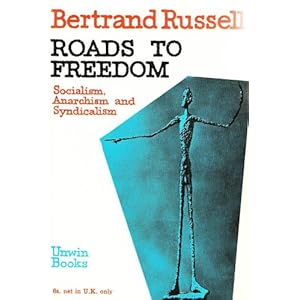
Roads to Freedom: Socialism, Anarchism, and Syndicalism Bertrand Russell Unwin Books 1918/1966 143 pages
Roads to Freedom: Socialism, Anarchism, and Syndicalism was first published in 1918 when the words in his title applied to large scale social movements rather than distant ideologies. It's author speaks of anarchism, syndicalism and socialism in the present tense, and refers to then recent events which are now historic. In 1918 things were happening, syndicalism was popular and the lives of Karl Marx and Mikhail Bakunin had ended not so long ago. The author of Roads to Freedom, Bertrand Russell, was polymath born of an aristocratic family. He held sympathies with socialism, anarchism and syndicalism which he expressed in detail in this slim volume. Russell was an avowed socialist at times in his life, and he occasionally returned to that subject in his writing throughout his career.
The first three chapters of Roads to Freedom comprise a section of the book titled ‘Historical’, which delves into the theories of Socialism (as they were derived from Marx and Engels), anarchism, (as derived from Mikhail Bakunin and Peter Kropotkin) and anarcho-syndicalism. In this text syndicalism appears to be the political philosophy the author is most sympathetic with, as he focused much of his writing on the formation and activities of trade unions, discussing the potential robustness of a society as managed by and for workers. This section of the book finds its author attempting to find the historical origins for the political theories he discusses, delving into the lives of the originating philosophers, as well as summarizing their ideas. Russell, despite his aristocratic roots, poses as advocate for some of these political ideals, particularly socialism and syndicalism.
The second section of the book, ‘Problems of the Future’, is focused on the practical matters of managing societies based around the ideologies of socialism, anarchism or syndicalism. Russell evaluates a number of important social and cultural questions against each set of ideals. Furthermore he interrogates the idealism behind certain aspects of these ideologies. For example he argues against the naive notion, still propounded by contemporary anarchists, that crime is the result of the capitalist system - he argues that many forms of crime will persist and were the world to turn to anarchism, the question would become how to deal with it in a society based on an anti-authoritarian ethos. Furthermore, he asks how are practical matters such as the arts to be supported under these systems, how is the defense of a country possible. He attempts to imagine the pros and cons of how each issue would be dealt with under each ideological system as it stood in the early 20th century. Furthermore, Russell does not simply raise issues but attempts to imagine workable answers to his own queries.
Russell’s book is an impressive analysis of the early 20th century European left. He took the ideologies of the left seriously, and while maintaining a sympathy with the spirit of these political systems he provides a positive critique on the practical matters that these systems would have to face, were they ever implemented as a system for broad social organization. Colin Ward’sAnarchy in Action, a history of the actual implementation of anarchist principles in various times and places, may serve as an interesting companion text for comparison to Russell’s strong analysis.